TaipeiPLAS 2026|Huarong Injection Molding Machines, Microcellular Foaming & AI Smart Manufacturing
2026-08-21 08:54:37
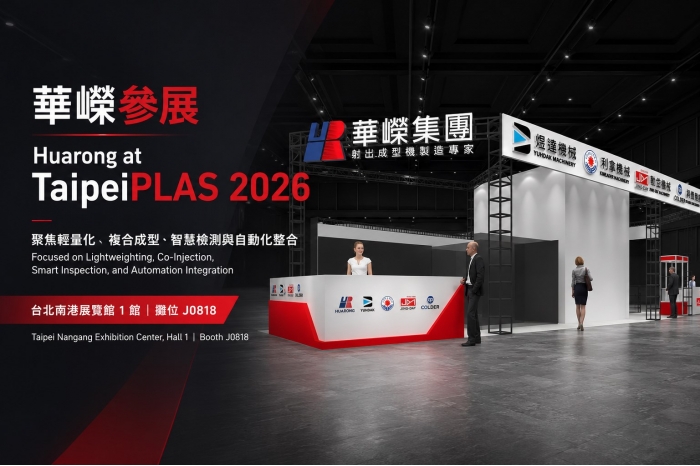
The 2026 Taipei International Plastics & Rubber Industry Show (TaipeiPLAS 2026) will take place from September 15 to 19 at Hall 1 of Taipei Nangang Exhibition Center. Huarong Group will exhibit HRF-200 Microcellular Foaming Injection Molding, HRM-200 Sandwich Injection Molding, a Low-Platform Vertical Injection Molding Machine, and an AI Smart Quality Inspection System at Booth J0818, showcasing Huarong's technology roadmap for the next stage of injection molding and smart manufacturing—from material reduction and multi-material design to human-machine operation and real-time quality judgment during the injection molding cycle.
As the manufacturing industry continues to face growing demands for lightweighting, material efficiency, quality consistency, and automated production, Huarong’s participation this year focuses not only on the performance of individual machines, but also on starting from actual product and process requirements to explore how injection molding equipment can further integrate with material applications, molds, automation, and quality management to form a complete production solution.
Learn More: Huarong TaipeiPLAS 2026 Exhibition Page
At TaipeiPLAS 2026, Huarong will focus its four showcased technologies on four common challenges faced in manufacturing:
1. How to reduce product weight and material usage
2. How to enable different materials to perform their respective functions within the same product
3. How to improve the operation and automation conditions of large vertical injection molding machines
4. How to bring quality inspection closer to the actual injection molding cycle
These four exhibits address materials, processes, equipment design, and quality control respectively, demonstrating Huarong’s development direction from injection molding machines to comprehensive process solutions.
Huarong will showcase the HRF-200 Microcellular Foaming Injection Molding Machine, which uses supercritical fluid technology. Nitrogen or carbon dioxide can be used according to process requirements to form a microcellular structure within the molten plastic.

Based on current technical data and different product conditions, the microcellular foaming process can be evaluated toward approximately 15% to 20% product weight reduction, 10% to 20% material savings, and approximately 30% to 50% reduction in required clamping force; under specific application conditions, cases with higher weight reduction ratios have also been achieved. Actual results still depend on product structure, material, mold, and process conditions.
Learn More:Huarong HRF Microcellular Foaming Exhibition Page
The HRM-200 Sandwich Injection Molding Machine exhibited at the show can form a material-layered structure of outer layer → core layer → outer layer (Skin/Core/Skin) within a single injection molding cycle.

The outer layer can focus on product appearance, color, or specific surface properties, while the core layer can be evaluated for recycled materials, functional materials, reinforcing materials, or foamed materials according to product requirements, allowing product design to no longer be limited to using the same material from the surface to the interior.
This technology enables manufacturers to further consider material configuration from a product-structure perspective, creating greater design flexibility among appearance, performance, material cost, and sustainable applications.
Learn More:Huarong HRM Sandwich Injection Molding Exhibition Page
Material efficiency is not simply about “reducing plastic usage,” nor is it simply about switching to recycled materials.
Once a product enters the development and mass-production stages, product weight, surface quality, mechanical properties, material flowability, mold design, and cost all interact with one another. Therefore, manufacturers need different technology pathways that can be selected according to product conditions.
HRF microcellular foaming and HRM sandwich injection molding represent two different material strategies. The former reduces the proportion of solid material inside the product through the molding process, while the latter reconfigures the position of different materials within the product cross-section.
Microcellular foaming is suitable for evaluating applications in certain automotive components, electronic products, sporting goods, transportation products, and industrial plastic parts. PP, PC/ABS, PA, glass-fiber-reinforced materials, and PCR recycled materials can all be further evaluated according to appearance, strength, and actual process conditions.
However, microcellular foaming is not suitable for every product. Product appearance requirements, transparency requirements, structural strength, material properties, and mold conditions all directly affect final feasibility. Therefore, at the exhibition, in addition to demonstrating the equipment, Huarong will also discuss application conditions and limitations based on customers’ actual products, rather than simply using weight reduction ratios as the sole criterion for equipment evaluation.
Further Reading:Microcellular Foam Injection Molding:A Complete Guide to Lightweight and Energy-Efficient Production
Further Reading:Microcellular vs Structural Foaming:Dimensional Stability & Surface Comparison
The key to sandwich injection molding is not simply having two injection units.
Material compatibility, viscosity, product wall thickness, gate location, mold design, flow balance, and the switching timing between Skin and Core materials all affect the final material distribution and product quality.
Therefore, the true engineering value of sandwich injection molding is to enable product developers to think separately about “what the outer layer needs” and “what the core layer needs” at the initial stage of product development, and then determine the final solution through the integration of materials, molds, and injection molding processes.

Learn More:Sandwich Injection Molding:How to Reduce Material Cost While Maintaining Surface Quality
Vertical injection molding machines are widely used for terminals, wires, connectors, electronic components, and metal insert applications such as insert injection molding.
As mold sizes and machine tonnage increase, the operating platform height may also increase accordingly. In actual production, this is not merely a matter of whether it is convenient for operators to get on and off the equipment; it can also directly affect the configuration of insert feeding, robotic arms, conveyors, and automated workstations.
Therefore, Huarong will use this exhibition to rethink the mechanical structure and production-line configuration of large vertical injection molding equipment from the perspective of working height.
The Low-Platform Vertical Injection Molding Machine exhibited this time is designed to reduce the working height of large vertical injection molding machines, allowing operators to more easily access the actual molding area when placing terminals, wires, metal inserts, and removing molded products.
For manual operations, this can reduce the operational complexity caused by frequent climbing onto elevated platforms; for automation planning, the lower working position can also facilitate the configuration of robotic arms, insert feeding systems, and other peripheral equipment.
Through this design, Huarong aims to ensure that the development of large vertical injection molding machines focuses not only on clamping force, injection capability, and mold space, but also incorporates operator ergonomics and future automation integration into the equipment design requirements.
Further Reading:Insert Molding Automation Guide:Machines, Robots, Tooling and ROI
Traditional vision inspection generally focuses on OK/NG judgment after products are completed. However, when an abnormality is only discovered after the next mold-closing cycle, there is still a time gap between quality inspection and actual machine control.
The AI Smart Quality Inspection showcased by Huarong this time focuses not simply on “adding a camera,” but on allowing information captured through vision inspection to be directly fed back into the injection molding process and used as the basis for determining the next machine action.
Huarong's current vision solutions include the HCM500 In-Mold Safety Monitoring Series and the HCP600 Product Quality Inspection Series.
HCM500 can confirm conditions such as residual material in the mold, insert position, completion of ejection, and whether the mold cavities are clear; HCP600 can configure cameras, lighting, and inspection programs according to actual product requirements for product features and quality judgment.
The vision system can complete image capture and judgment between mold opening and the next mold-closing cycle. When the result is OK, the equipment can continue to the next production cycle according to the settings; if the result is NG, automatic operation can be stopped and an alert issued, waiting for personnel confirmation.
This allows quality inspection to move from post-production screening to becoming part of the injection molding cycle.
Related signals can also be integrated with I/O, PLC, production records, and MES systems according to actual requirements, establishing a more complete data foundation for subsequent quality traceability and smart manufacturing.
Learn More:Huarong AI Smart Quality Inspection & Machine Vision
When a plastic product truly enters stable mass production, it usually involves more than the injection molding machine itself.
Material handling, compounding, temperature control, molds, injection molding, part removal, automation, and quality inspection all interact with one another. Therefore, at TaipeiPLAS 2026, in addition to showcasing its own injection molding technologies, Huarong also hopes to work through industry collaboration to enable customers to discuss more of the actual production-line engineering requirements based on a specific product need.
This is also an important direction in the planning of Booth J0818.
This time, Huarong will exhibit together with YUHDAK Machinery, KNEADER Machinery, JING-DAY Machinery, and COLDER, connecting different areas of process expertise including injection molding, vertical equipment, peripheral systems, cooling, and material compounding.
The purpose of industry collaboration is not to replace the specialized engineering required for individual equipment, but to enable customers bringing their products, materials, molds, and production capacity requirements for equipment evaluation to simultaneously consider more of the actual conditions required for mass production.
For Huarong, the injection molding machine is an important core of the production system, but what customers ultimately need to solve is a production process that can operate stably.
This also continues the philosophy that Huarong has long upheld:
“Pursuing Innovative High Quality, Creating Value Through Industry Alliances.”
Learn More About Huarong Injection Molding Automation and Turnkey Solutions
From HRF-200 Microcellular Foaming exploring material reduction and lightweighting, HRM-200 Sandwich Injection Molding applying multi-material configuration, and the Low-Platform Vertical Injection Molding Machine rethinking operator and automation working height, to the AI Vision System directly participating in the injection molding cycle, the four technologies exhibited this time address different manufacturing challenges, but share the same underlying development direction.
Huarong believes that the competitiveness of injection molding equipment in the next stage lies not only in clamping force, injection speed, or equipment specifications, but more importantly in whether the equipment can work with product, material, mold, and overall production-line conditions to help manufacturers improve material efficiency, process stability, quality management, and automation.
TaipeiPLAS 2026 will also serve as an important platform for Huarong to engage face-to-face with global customers, industry partners, and engineering teams to discuss these manufacturing challenges.
If you are planning a new injection molding project, you are welcome to bring product drawings, material information, product weight, mold conditions, and planned production capacity to Booth J0818 to further discuss equipment and process feasibility with the Huarong team.

During the exhibition, Huarong will showcase related equipment and technologies at Booth J0818, with the team providing on-site consultation on injection molding, material applications, and automation solutions.
- Exhibition Name:TaipeiPLAS 2026 Taipei International Plastics & Rubber Industry Show
- Exhibition Dates:September 15 to 19, 2026
- Venue:Taipei Nangang Exhibition Center, Hall 1
- Huarong Booth:J0818
View Huarong TaipeiPLAS 2026 Complete Exhibition Information
- Group Name: Huarong Group
- Brand: Huarong, Yuhdak, Nanrong
- Service Offerings: Injection Molding Machine, Vertical Injection Molding Machine, Injection Molding Automation
- Tel: +886-6-7956777
- Address: No.21-6, Zhongzhou, Chin An Vil., Xigang Dist., Tainan City 72351, Taiwan
- Official Website: https://www.huarong.com.tw/