Precision Thread Unscrewing and High-Speed Injection for High-Volume Food Packaging Components
2026-08-27 15:40:04
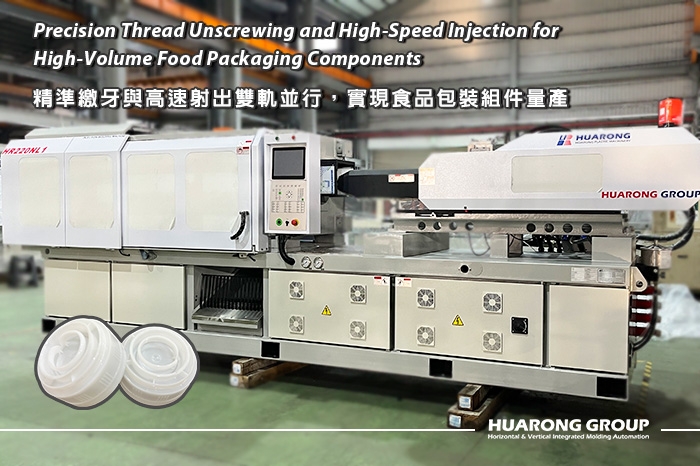
When mass-producing food packaging components such as edible oil bottle caps, flip-top closures, inner plugs, or high-toughness handles, simply pursuing production speed is not enough. Edible oil cap injection molding requires synchronized mold movements, stable injection, precise thread demolding, and repeatable cooling performance. Huarong's HRN Series General-Purpose Injection Molding Machine is designed to meet these requirements through a high-rigidity inward toggle clamping structure and configurable molding solutions.
The primary challenge in food packaging injection molding is maintaining production efficiency without compromising sealing performance, dimensional consistency, or component durability. Bottle caps may appear simple, but their threads, sealing surfaces, hinge structures, inner plugs, and tamper-evident features can all affect the final packaging performance.
For manufacturers, this means the injection molding machine must operate as part of the complete process rather than simply providing sufficient clamping force and injection pressure. Mold opening speed, injection stability, cooling efficiency, ejection, and downstream automation can all affect actual cycle time and yield. Huarong’s previous technical content also points out that plastic bottle caps are high-volume components, and stable injection conditions and appropriate demolding mechanisms are essential for maintaining production quality.

Further Reading:The Science Behind Plastic Caps:How are Plastic Bottle Caps Made
- Large food and edible oil bottle caps
- Screw caps
- Flip-top closures
- Inner plugs and sealing components
- Plastic handles for containers
- High-toughness packaging components
- Other PE and PP packaging components
For these products, the production objective is not simply “ faster injection ” but rather shortening and improving the repeatability of the overall cycle time while protecting critical product features.
A high-speed toggle injection molding machine can improve production efficiency by reducing unnecessary mold movement time while maintaining stable clamping and mold opening movements. In high-volume production applications, even a small reduction in cycle time can generate significant benefits when multiplied across thousands or even millions of components.
The general-purpose hydraulic injection molding machine adopts a high-rigidity inward toggle clamping structure, designed for rapid mold closing and opening as well as repeatable platen movement. It can be applied to packaging containers, automotive components, electronic products, and consumer products.
For the food packaging applications described in this article, the specified Huarong configuration can achieve a 15% increase in mold opening mechanism speed. The actual benefit is not simply higher mechanical speed, but reducing the proportion of mold movement within the overall molding cycle, creating more room for injection and cooling optimization.
However, machine speed should always be evaluated together with mold design, cavity count, product geometry, cooling performance, and material. If the product still requires a longer cooling time, or if demolding is unstable, faster mold opening does not necessarily guarantee a shorter cycle time.
A practical production calculation is:
Annual production = Number of cavities × Injection cycles per hour × Operating hours × Utilization rate × Yield
This clearly explains why machine selection should not focus only on injection speed. For example, increasing the cavity count can increase output per mold cycle, while improving mold opening and demolding can shorten the time required for each cycle. Stable process control can also increase effective output by reducing defective products.
Therefore, for purchasing and production management personnel, the more important question is:
Can the machine maintain the required product quality at the target cycle time under actual production conditions?
This question is more valuable than simply comparing a single maximum machine speed specification.
When bottle caps have internal or external threads, precise thread demolding is critical because the molded features must be released without damaging the thread profile. If the mold and demolding sequence are not properly coordinated, excessive mechanical force may cause thread damage, deformation, sticking, or inconsistent sealing performance.
For threaded packaging components, the demolding solution may use core pulling, rotary demolding, or other specialized mechanisms depending on the geometry. Internal undercuts or threaded structures may require a core-pulling device to assist in releasing the product before mold opening. This is particularly important for edible oil bottle caps because the cap is not merely an appearance component; its threads and sealing interface must properly mate with the container neck. Damaged or deformed threads may affect cap torque, sealing performance, leak resistance, and the downstream capping process.
Therefore, the machine needs to coordinate:
1. Injection and pressure control
2. Cooling and solidification
3. Thread or core release
4. Mold opening
5. Ejection
6. Automated part removal
The actual demolding mechanism should be selected according to the bottle cap geometry, thread design, mold structure, resin, target cycle time, and required production volume.

Large packaging components and high-toughness components require a different molding approach from thin-wall rigid bottle caps. Materials such as LDPE offer good flexibility and impact resistance, but this flexibility can also make dimensional control more challenging during injection and cooling.
Plastic handles are a typical example. If melt flow behavior, injection pressure, cooling balance, or mold temperature are not properly controlled, the handle may deform or develop dimensional deviations after ejection.
For these applications, the process should be optimized around the relationship between material flow, injection speed, pressure, holding pressure behavior, cooling, and product geometry. Simply increasing injection pressure may not solve deformation problems because excessive pressure can introduce additional residual stress or cause other molding defects.
A better engineering approach is to evaluate:
- Gate location and flow balance
- Injection speed profile
- Injection pressure and pressure limit
- Holding pressure and holding time
- Mold temperature
- Cooling channel configuration
- Product wall thickness
- Ejection timing
- Material shrinkage and molecular orientation
For flexible packaging components, the objective is to reduce post-molding deformation while ensuring complete filling and structural strength. The final settings should be established through mold trials and material-specific process validation rather than relying on generic parameter settings.
Machine rigidity directly affects repeatability because the clamping unit must maintain stable mold alignment and clamping force distribution throughout repeated production cycles. For high-volume packaging production, even small variations can accumulate into flash, dimensional deviations, or inconsistent sealing features.
The HRN Series adopts a high-rigidity inward toggle clamping structure. Its tie bars and platens are designed to improve rigidity, alignment accuracy, and resistance to deformation. The centralized progressive lubrication system is used to distribute lubricant to moving components, reducing mechanical wear.
Through its boat-type base design, overall structural deformation is reduced by 65%. This figure should be understood as a machine structural design specification rather than a guarantee of reduced product warpage. Actual product deformation still depends on mold design, material, processing conditions, and cooling.
Maintenance convenience is also an important practical consideration. The HRN Series is equipped with a detachable front safety guard to improve accessibility around the mold area, facilitating mold changes and routine maintenance. For factories operating multiple machines continuously for extended periods, maintenance convenience can have an impact on overall equipment availability that may be just as important as maximum machine performance.

The optimal machine for food packaging should be selected according to the complete production requirements rather than machine tonnage alone. Engineers should first confirm the product, material, mold, target cycle time, cavity count, and annual production requirements before determining the appropriate injection molding machine.
| Decision Criteria | Evaluation Content | Importance to Packaging Production |
| Clamping force | Clamping force required based on projected area and process conditions | Prevents flash and maintains dimensional consistency |
| Shot size | Comparison of actual product weight + runner weight with machine injection capacity | Ensures sufficient filling and avoids excessive residence time |
| Mold opening stroke | Mold opening stroke required by the mold and product | Affects demolding and cycle time |
| Mold thickness | Compatibility with minimum/maximum mold thickness | Ensures proper mold installation |
| Tie-bar spacing | Mold width and installation requirements | Ensures actual installation compatibility |
| Injection control | Pressure, speed, and repeatability | Affects filling, sealing features, and appearance |
| Demolding | Core pulling, rotary demolding, or ejection requirements | Protects threads and complex geometric features |
| Cycle time | Injection + holding pressure + cooling + mold movements + ejection | Determines actual production capacity |
| Automation | Robot, conveyor, inspection, liner insertion, or downstream equipment | Reduces manual operation and improves production consistency |
| Maintenance | Lubrication, maintenance accessibility, wear parts, mold-change space | Affects long-term operating costs |
Huarong's bottle cap production case also emphasizes that when planning a continuous production line, high-cavity molds, stable injection pressure, clamping repeatability, and downstream automation should all be considered together.
When manufacturers need a general-purpose injection molding platform to support stable high-volume production of packaging and other plastic components, the HRN Series is suitable for such requirements. Its inward toggle clamping structure, hydraulic system, mold position detection, lubrication design, and maintenance-oriented features enable it to support a wide range of injection molding requirements.
For food packaging components with threads or special structures, its primary advantage lies in the ability to configure the machine and molding process according to product requirements, rather than treating every application as a standard injection cycle.
This is particularly important when a single factory needs to produce multiple packaging products. A general-purpose injection molding machine can provide a flexible production platform, while application-specific molds and peripheral configurations can address the special requirements of different components.
The final machine specifications should still be confirmed through an application evaluation, including product drawings, material data, mold configuration, cavity count, target cycle time, and production volume.
High-volume food packaging production should be viewed as a coordinated manufacturing system. Faster mold movements can shorten cycle time, but precise demolding protects critical threads; stable injection maintains dimensional consistency; appropriate cooling reduces deformation; and automation reduces unnecessary manual operations.
Huarong’s existing bottle cap solutions demonstrate this systematic approach by integrating injection molding machines with molds and downstream automation equipment, such as bottle cap cutting and folding equipment. For manufacturers producing edible oil bottle caps, flip-top closures, inner plugs, or high-toughness handles, the real question should not simply be “ How fast is the injection molding machine?” The more valuable question is:
“ Can the complete molding system repeatedly and consistently produce products that meet requirements at the target cycle time while maintaining critical dimensions, threads, sealing surfaces, and mechanical properties?”
This is where machine configuration, mold engineering, process control, and automation need to operate together. For manufacturers evaluating edible oil cap injection molding, the HRN Series provides a configurable general-purpose platform for high-volume packaging requirements. The appropriate machine model and peripheral configuration should be determined according to actual product and mold conditions to achieve a balance among cycle time, product quality, maintenance convenience, and overall production costs.
A general-purpose hydraulic injection molding machine with stable clamping, injection control, and appropriate demolding capabilities can be used for plastic edible oil bottle caps. The final machine selection depends on cap weight, cavity count, material, mold dimensions, target cycle time, and thread demolding requirements.
Thread demolding is important because internal or external threads must be released without damaging their geometric structure. Improper demolding may cause sticking, thread damage, dimensional deviations, or sealing problems. Depending on the product design, a core-pulling or rotary demolding mechanism may be required.
Yes. Huarong positions the HRN Series as a general-purpose machine suitable for high-volume production applications, including packaging. Its high-rigidity inward toggle clamping structure can support repeatable mold movements, while the machine can also be configured according to specific application requirements.
PP and PE are commonly used materials for plastic bottle caps because they offer advantages such as light weight, chemical resistance, and toughness. The suitable resin depends on the packaging application, sealing requirements, mechanical properties, regulatory requirements, and processing conditions.
Cycle time can be shortened by optimizing mold opening and closing, injection and holding pressure conditions, cooling, demolding, and automation as a complete system. Simply increasing machine speed may not shorten the total cycle time. If cooling or demolding remains the limiting factor, the overall cycle time will still be affected.
Please provide product drawings or samples, product weight, material, mold dimensions, cavity count, target cycle time, estimated production volume, thread or core-pulling requirements, and automation requirements. This information enables the machine configuration, clamping specifications, and injection specifications to be evaluated according to actual production conditions.
- Group Name: Huarong Group
- Brand: Huarong, Yuhdak, Nanrong
- Service Offerings: Injection Molding Machine, Vertical Injection Molding Machine, Injection Molding Automation
- Tel: +886-6-7956777
- Address: No.21-6, Zhongzhou, Chin An Vil., Xigang Dist., Tainan City 72351, Taiwan
- Official Website: https://www.huarong.com.tw/