LCP Injection Molding for High-Speed Connectors:Processing Challenges and Machine Selection
2026-11-26 13:46:54
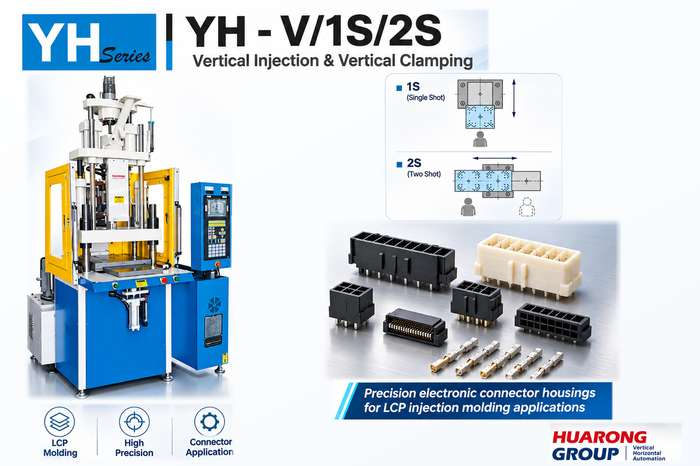
Liquid crystal polymer (LCP) is widely used in precision electronic connectors due to its excellent flowability, heat resistance, and dimensional stability. Successful LCP injection molding requires careful control of thin-wall filling, molecular orientation, weld lines, and thermal history, supported by appropriate mold design and selection of the injection molding machine.
As electronic devices shrink and data transmission speeds increase, connector manufacturers need materials that meet demanding dimensional, thermal, and electrical requirements.
Thermoplastic liquid crystal polymer (LCP) offers several advantages for precision electronic components.
| Material Property | Manufacturing Advantage |
| High flowability | Supports thin-wall and complex component molding. |
| Heat resistance | Suitable grades can withstand soldering and electronic assembly processes. |
| Dimensional stability | Supports precise terminal positioning and connector alignment. |
| Low moisture absorption | Helps minimize moisture-related dimensional changes. |
| Electrical properties | Supports insulation and high-frequency applications, depending on the resin grade. |
Typical LCP applications include fine-pitch connectors, board-to-board connectors, CPU sockets, memory interfaces, and high-speed I/O connectors.
Actual material performance depends on the selected LCP grade, reinforcement system, component design, and application requirements.
LCP exhibits shear-thinning behavior, meaning its melt viscosity decreases as the shear rate increases. This characteristic makes suitable LCP grades attractive for molding miniature components with complex geometries.
However, restrictive gates, long flow paths, and rapid solidification may cause incomplete filling.
Manufacturers must evaluate material flowability, cavity geometry, and machine injection response together to achieve consistent filling.
LCP molecules tend to align in the direction of melt flow during injection molding. This creates anisotropic behavior, meaning that material properties and shrinkage can differ between the flow and transverse directions.
Uneven orientation and directional shrinkage may affect connector flatness, terminal pitch, and dimensional accuracy.
Appropriate gate positioning, balanced filling, and part design are therefore important for controlling warpage.

Electronic connector housings often contain numerous terminal openings, thin ribs, and locking features.
When melt flows around these structures and rejoin, weld lines may form. Depending on their location and molding conditions, weld lines can affect local mechanical strength.
Gate design, mold venting, and application-specific mechanical testing should be considered during product development.

Excessive thermal exposure, unsuitable drying conditions, and prolonged material residence time may contribute to discoloration, blistering, or material degradation.
Since LCP processing requirements vary by grade, manufacturers should follow the resin supplier's recommendations rather than applying universal processing parameters.
Stable LCP injection molding requires coordination between material preparation, mold design, and process control.
| Key Factor | Engineering Considerations |
| Gate and runner design | Flow orientation, cavity balance, and weld-line location |
| Mold venting | Trapped gas and incomplete filling |
| Material preparation | Resin grade, drying requirements, and thermal history |
| Temperature control | Melt temperature and mold temperature stability |
| Injection control | Injection response, pressure, and V/P switchover |
| Plasticizing system | Screw recovery, back pressure, and residence time |
For complex connector housings, mold flow analysis and progressive short-shot trials can help evaluate filling patterns before establishing production conditions.
Further reading:Injection Molding Process Parameters.
Precision connector components typically require careful matching of shot size and injection unit capacity.
An oversized injection unit may increase material residence time, while an undersized unit may limit shot capacity or plasticizing performance.
Machine selection should consider part weight, cavity count, runner weight, screw diameter, and production cycle requirements.
Learn more about Screw Diameter, Shot Size and Residence Time and Shot Weight Analysis.
Maximum injection speed alone does not determine whether a machine is suitable for thin-wall LCP molding.
The machine must respond quickly enough to achieve the required injection velocity and maintain consistent filling conditions.
Key evaluation criteria include:
- Injection acceleration and velocity response
- Available injection pressure
- Injection position and V/P switchover repeatability
- Shot preparation and cushion consistency
- Temperature control stability
Evaluate these capabilities against the actual product and mold requirements.
Reinforced LCP grades may require enhanced wear resistance, while certain grades require higher processing temperatures.
The screw, barrel, nozzle, heating system, and temperature control capability should therefore be evaluated according to the selected resin's technical specifications.
Select the machine configuration based on the component design, mold structure, and production method.
| Machine Configuration | Typical Applications |
| Horizontal injection molding machine | Standalone connector housings and automated multi-cavity production |
| Vertical injection molding machine | Connector components requiring metal terminal inserts and precise insert positioning |
| Rotary or sliding-table vertical machine | Insert molding applications requiring repeated loading and unloading operations |
For applications involving metal terminals or other inserts, Huarong Group's vertical injection molding machines provide different configurations for mold access, insert handling, and production automation.
Related application:Electrical Connector Insert Molding.
Suitable LCP grades combine high flowability, heat resistance, and dimensional stability, making them attractive for miniature electronic components with complex geometries and demanding tolerances.
Warpage may result from directional shrinkage, uneven molecular or fiber orientation, gate positioning, part geometry, and temperature variation.
Many thermoplastic LCP grades can be processed using conventional injection molding machines. However, injection response, shot capacity, temperature capability, and injection unit configuration must meet the specific material and application requirements.
Vertical injection molding is particularly worth evaluating when connector production requires metal terminal inserts, precise insert positioning, or automated insert-loading operations.
Successful LCP connector production requires coordination between material selection, mold design, process control, and injection molding equipment.
When evaluating an injection molding machine for your application, please prepare the following information:
- Product drawings and dimensional requirements
- LCP material grade and technical datasheet
- Part weight, cavity count, and mold specifications
- Production targets and automation requirements
Contact Huarong Group to discuss the appropriate injection molding machine configuration for your application.
- Group Name: Huarong Group
- Brand: Huarong, Yuhdak, Nanrong
- Service Offerings: Injection Molding Machine, Vertical Injection Molding Machine, Injection Molding Automation
- Tel: +886-6-7956777
- Address: No.21-6, Zhongzhou, Chin An Vil., Xigang Dist., Tainan City 72351, Taiwan
- Official Website: https://www.huarong.com.tw/