From Outsourcing to In-House Production:Building an Efficient Bottle Cap Line
2026-02-05 09:41:33
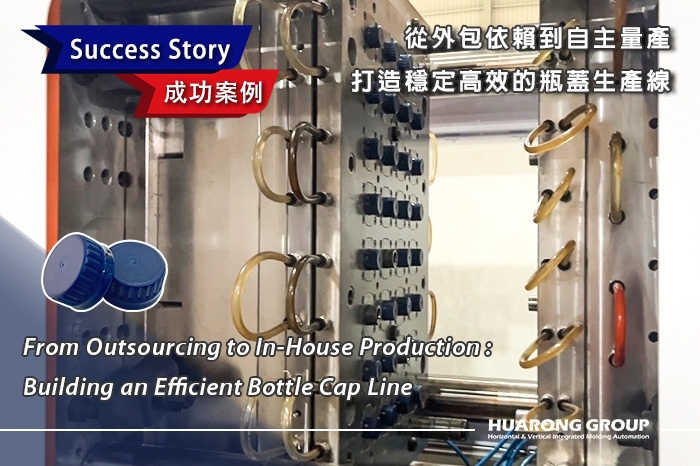
This case study documents how a beverage packaging manufacturer addressed unstable supply, quality variation, and cost pressures in plastic bottle cap manufacturing by transitioning from outsourced production to an in-house production line. The solution integrates an injection molding machine with automated cap slitting and folding equipment for tamper-evident closures. The implementation logic and operating conditions are aligned with established production-line integration practices and are verifiable through the corresponding technical guide and production-line video.
The customer previously relied on outsourced plastic bottle cap manufacturing suppliers to support bottled beverage packaging. This sourcing model introduced operational constraints that affected production continuity:
- Unstable supply lead time
External delivery schedules were not fully aligned with the bottling line plan. When cap delivery was delayed, downstream filling and packaging operations could not proceed as scheduled. - Limited control over dimensional consistency
Cap dimensions and tamper-evident band geometry varied between batches. These variations increased inspection workload and introduced variability in sealing during capping. - Higher operational cost under urgent demand
Expedited shipments and buffer inventory were required to mitigate delivery uncertainty. These costs increased with demand volatility and order frequency.
These constraints prompted the evaluation of an in-house bottle cap production line using an injection molding machine with downstream automation.
Bottle caps are high-cavity molded parts produced under short cycle time conditions. Process stability and repeatability determine production reliability.
Key requirements identified during process planning:
- Cycle stability under continuous operation
Variations in injection pressure, melt temperature, or clamping stability can lead to short shots, flash, or inconsistent tamper-evident band geometry in high-cycle bottle cap production. - Process integration for tamper-evident closures
Tamper-evident bands can be formed in the mold or processed by cap slitting and folding machines. The selected configuration combined injection molding with downstream trimming to reduce mold complexity while maintaining consistent band separation and folding geometry. - Equipment durability for extended operation
Continuous production requires stable clamping, repeatable injection control, and mechanical durability over long operating hours.
These requirements align with production-line design principles summarized in the technical reference on bottle-cap production-line integration.
Further reading:Bottle Cap Production Line: Injection Molding, Cap Mold, and Cap Slitting & Folding Integration
The customer implemented an integrated bottle cap production line consisting of:
- Injection molding machine configured for plastic bottle cap manufacturing
- Bottle cap mold designed for stable demolding
- Automated cap slitting and folding machine for tamper-evident closure production
- Inline handling integration to reduce manual transfer
This configuration enabled continuous flow from injection molding to cap trimming. The system logic and machine integration method are demonstrated in the production line reference video.
The HRU and HRN series are Huarong’s standard hydraulic injection molding machines, designed for stable mass production of general plastic products. In plastic bottle cap manufacturing, machine selection prioritizes production stability under high-cycle operation over peak output alone. The HRU and HRN series meet the technical conditions required for continuous bottle cap production lines integrated with automated cap slitting and folding systems.
Key machine design and performance characteristics relevant to bottle cap production include:
- High-rigidity toggle clamping structure
The toggle clamping mechanism provides stable clamping force and repeatable platen movement under short cycle time operation. This structure helps reduce flash and dimensional variation in bottle cap geometry when operating multi-cavity cap molds for continuous production. - Stable and durable hydraulic power system
The hydraulic system is designed for smooth motion control and repeatable pressure response. This supports consistent injection pressure and melt temperature control, which is required to maintain stable tamper-evident band formation before downstream trimming. - CE-certified safety protection module
The machine complies with CE safety requirements. This supports stable operation in export-oriented production environments while maintaining operator safety during continuous production cycles. - Patented detachable front safety guard design
The detachable safety guard improves access to the mold area during mold change and maintenance. This design reduces downtime during routine mold replacement and supports production line availability in bottle cap manufacturing environments with frequent mold servicing schedules.
This configuration supports stable bottle cap production when used with a bottle cap mold and an automated cap slitting and folding machine.
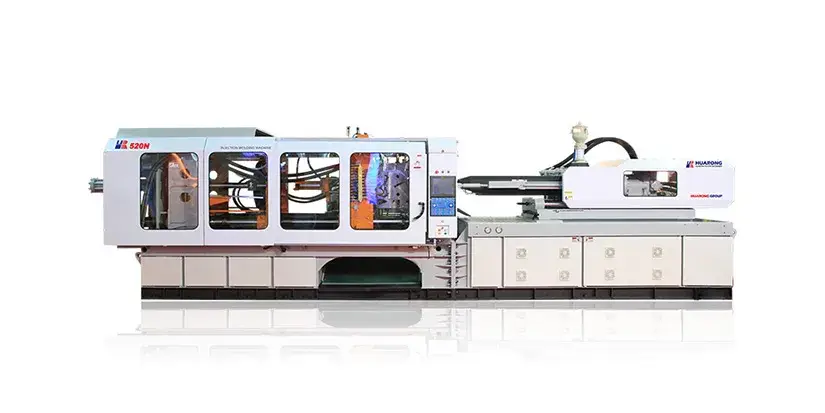
Suggested Machine: General Injection Molding Machines – HRN & HRU Series
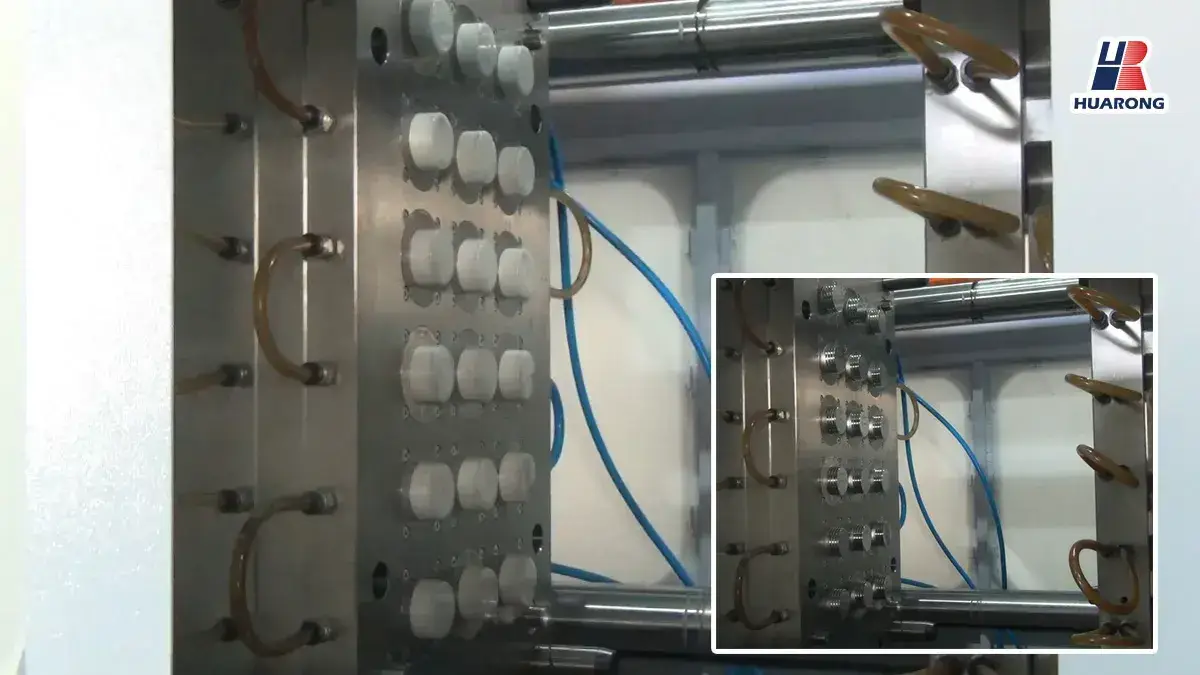
The production line video provides a visual reference for how the injection molding machine is integrated with automated cap trimming equipment in a continuous workflow.
After commissioning, the customer observed changes under normal production conditions:
- Supply lead time became internally controllable
Bottle cap output scheduling was aligned with the bottling line plan. The risk of production interruptions from external delivery delays was reduced. - Dimensional consistency improved across batches
With controlled injection parameters and automated trimming, variation in cap geometry and tamper-evident band separation was reduced between production runs. - Reduced dependence on urgent logistics and buffer inventory
In-house production reduced the need for expedited shipping and large safety stock. Inventory planning could be adjusted based on internal production scheduling.
These outcomes align with the expected results of injection molding automation combined with cap trimming integration.
Manufacturers evaluating a bottle cap production line using an injection molding machine may consider the following conditions:
- Injection molding machine selection should prioritize repeatable clamping and injection stability for high-cycle production.
- Cap trimming integration should account for transfer timing to prevent deformation prior to slitting and folding.
- Process validation should include continuous operation trials to verify dimensional repeatability under extended production conditions.
These considerations reflect general integration logic for plastic bottle cap manufacturing systems.
Transitioning from outsourced bottle cap sourcing to an in-house bottle cap production line, based on an integrated injection molding machine and automated trimming equipment, converted external delivery risk into controllable internal process variables. This approach provides a structured method for stabilizing supply, ensuring product consistency, and aligning production planning with bottling-line demand.
At Huarong, we not only provide injection molding machines but are also committed to helping customers build integrated solutions tailored to their production line needs. From planning and implementation, from machine setup to mass production, from operations to management, we are your best partner on the path to smart manufacturing and sustainable competitiveness.
- Group Name: Huarong Group
- Brand: Huarong, Yuhdak, Nanrong
- Service Offerings: Injection Molding Machine, Vertical Injection Molding Machine, Injection Molding Automation
- Tel: +886-6-7956777
- Address: No.21-6, Zhongzhou, Chin An Vil., Xigang Dist., Tainan City 72351, Taiwan
- Official Website: https://www.huarong.com.tw/