Injection Molding Plant Setup: Factory Layout, Utilities, Equipment and Commissioning
2026-09-16 14:57:25
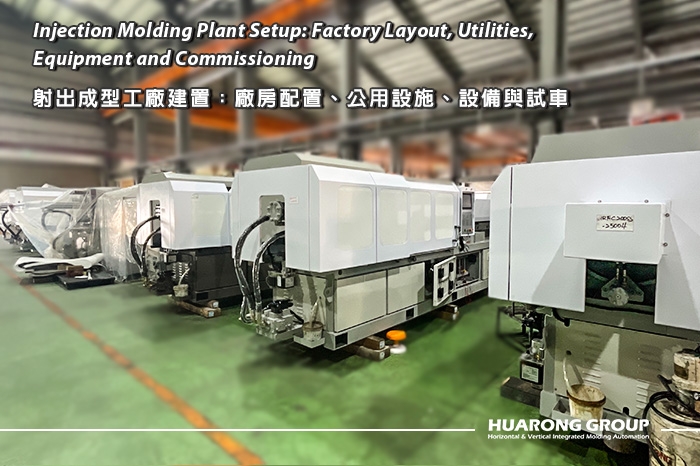
Setting up an injection molding plant involves far more than selecting injection molding machines and placing them on a factory floor. A reliable production facility must coordinate machines, molds, raw materials, cooling systems, compressed air, auxiliary equipment, automation, material flow, maintenance access, and future expansion.
For companies preparing a new plastic injection plant, expanding an existing injection molding factory, or developing a turnkey production line, these factors should be considered as one integrated system.
A well-planned injection molding plant setup can improve production flow, simplify maintenance, reduce unnecessary material handling, and provide the infrastructure needed for stable long-term operation. The planning process should therefore begin with the products and production targets, then translate those requirements into factory layout, utility capacity, equipment selection, machine installation, and automation planning.
This guide explains the major considerations involved in an injection molding plant setup, from initial factory input data through commissioning and production acceptance.

The product is the starting point for injection molding plant planning. Different applications may require different machine configurations, injection performance, temperature control, material handling systems, or automation.
The resin should also be identified at an early stage. Common engineering considerations include material type, drying requirements, processing temperature, material consumption, and sensitivity to moisture.
Understanding the application also helps determine quality requirements. Food packaging, automotive components, medical products, and general industrial parts may have very different requirements for dimensional consistency, cleanliness, traceability, and production control.
Mold specifications directly affect machine selection and factory layout.
Important information includes:
- Mold dimensions
- Mold weight
- Mold thickness
- Required mold opening
- Cavity count
- Runner configuration
- Cooling requirements
- Mold-change method
The cavity count is particularly important because it influences the required production capacity and cycle time. A multi-cavity mold may produce significantly more parts per cycle, but it may also require greater injection capacity, more precise process control, and additional downstream handling.
Mold dimensions and weight should also be considered when planning crane access, mold-change routes, storage areas, and maintenance space.
Production targets should be converted into measurable requirements before machine quantities are determined.
A basic production estimate can be based on:
Required output = Parts per cycle × Number of cavities × Production cycles
Actual output will depend on cycle time, machine availability, planned operating hours, scrap rate, mold changes, maintenance, and other production factors.
Cycle time should therefore be considered together with cavity count and machine utilization rather than evaluated independently.
For high-volume production, even a small reduction in cycle time can have a significant effect on annual output. Conversely, selecting machines solely according to theoretical output without considering cooling capacity, mold performance, material preparation, and automation can create bottlenecks elsewhere in the production line.
Once product and mold requirements are defined, the required injection molding machine specifications can be evaluated.
Key data may include:
- Required clamping force
- Injection volume or shot size
- Injection pressure
- Injection speed
- Mold dimensions
- Machine platen dimensions
- Machine voltage and power requirements
- Required automation interface
Machine quantity should be based on both current production demand and the expected production mix.
A plant producing several product families may require machines across different clamping-force ranges rather than relying on one machine size. Standardizing selected machine groups can simplify maintenance and operator training while still providing flexibility for different molds.
A new plant should not be designed only for today's production volume.
If production is expected to increase, the layout should reserve suitable space for additional machines, auxiliary equipment, electrical capacity, cooling infrastructure, material handling, and automation.
Expansion planning is particularly important because adding a machine later may require more than floor space. Utility headers, cable routes, chilled-water capacity, compressed-air capacity, and material conveying systems may all need additional capacity.
Planning these requirements in advance can reduce the cost and disruption associated with future expansion.
The factory layout should support a logical production flow from incoming raw materials to finished products.
A typical injection molding plant can be organized around the following sequence:
Raw Material Storage → Drying / Conveying → Injection Molding Cells → Robot / Automation → Quality Inspection → Packing → Finished Goods Warehouse
The objective is not simply to minimize physical distance. The layout should also reduce unnecessary movement, avoid crossing material flows, maintain access to equipment, and support safe maintenance and mold changes.
Raw materials should have a defined receiving and storage area that allows incoming resin to be identified, inspected, and transferred into production.
Storage planning should consider:
- Resin volume
- Packaging format
- Material identification
- FIFO requirements where applicable
- Environmental conditions
- Material transfer routes
If different materials are used across the plant, clear identification and segregation can help reduce the risk of material mix-ups.
Where resin drying is required, dryers should be positioned with consideration for both material flow and maintenance access.
For centralized material handling, the plant may use a network connecting material storage, drying systems, receivers, and individual molding machines.
The conveying system should be planned according to material throughput, conveying distance, machine quantity, and future expansion.
The objective is to establish a reliable material supply without creating unnecessary pipe routing or restricting access to machines.
Injection molding machines are the core production units of the plant.
Rather than arranging machines only according to available floor space, planners should consider:
- Operator access
- Mold-change access
- Robot installation
- Conveyor placement
- Utility connections
- Maintenance clearance
- Material flow
- Product removal
- Future machine expansion
For automated production, the injection molding machine and downstream equipment should be treated as one production cell.
Robots may remove molded parts, perform insert handling, transfer products, separate runners, or communicate with downstream equipment.
The required robot reach, payload, motion range, cycle time, and installation position should be evaluated together with the machine and mold.
Downstream equipment such as conveyors, inspection systems, packaging equipment, and part separation units should also be considered during cell layout planning.
Quality inspection should be positioned so that products can be checked without disrupting the main production flow.
Depending on the application, inspection may include dimensional checks, visual inspection, weight measurement, leak testing, functional testing, or automated vision inspection.
The packing area should then provide sufficient space for packaging materials, operators, finished products, and temporary storage.
The finished-goods area should be separated logically from raw-material storage and production areas.
Warehouse planning should consider:
- Expected production volume
- Packaging dimensions
- Pallet configuration
- Shipping frequency
- Forklift routes
- Inventory rotation
- Loading and unloading access
A well-defined warehouse flow helps prevent finished products from interfering with production traffic.
Maintenance access is often overlooked during initial factory planning.
Every machine should have sufficient space for routine inspection, component replacement, electrical work, hydraulic or mechanical maintenance, and mold handling.
Material flow should also be evaluated from multiple perspectives:
Raw material → Machine → Finished part → Inspection → Packing → Warehouse → Shipping
At the same time, maintenance and mold movement require separate routes that should not unnecessarily interfere with daily production.
Utilities are the infrastructure that allows an injection molding plant to operate continuously. Insufficient utility capacity can become a production constraint even when the machines themselves are properly selected.
Electrical planning should consider the rated requirements of injection molding machines as well as auxiliary equipment and automation systems.
The plant design should account for:
- Machine voltage
- Installed power
- Peak electrical demand
- Distribution equipment
- Cable routing
- Control systems
- Auxiliary equipment
- Future expansion capacity
The actual electrical design should be verified by qualified electrical professionals according to the machine specifications and applicable local requirements.
Cooling is one of the most important utilities in injection molding because mold temperature and machine heat management directly affect production conditions.
Cooling requirements may involve:
- Injection molding machines
- Mold cooling circuits
- Oil or hydraulic systems where applicable
- Chillers
- Cooling towers
- Heat exchangers
The required water flow and temperature should be considered rather than focusing only on chiller capacity.
An inadequate cooling system can affect cycle time, product consistency, and equipment operating conditions.
Mold temperature controllers provide localized temperature regulation for individual molds.
When planning the factory, the location of temperature controllers and their connection to the molds should be considered alongside machine placement.
For production with frequent mold changes, easy access to temperature-control equipment can simplify setup and reduce changeover time.
Compressed air may be required by robots, pneumatic components, valves, part handling systems, and other factory equipment.
Planning should consider:
- Required pressure
- Air consumption
- Compressor capacity
- Air quality
- Distribution piping
- Pressure losses
- Future equipment
The plant should provide sufficient capacity under actual operating conditions rather than sizing the compressor only according to nominal demand.
Injection molding equipment generates heat, particularly in facilities with multiple machines operating continuously.
Ventilation and heat management should therefore be considered during factory design.
The appropriate solution depends on machine density, building conditions, climate, process requirements, and the amount of heat generated by equipment.
A comfortable working environment can also support operator efficiency and equipment maintenance.
Cooling systems and other utilities may require drainage or dedicated routing.
Utility piping and electrical routes should be planned to avoid obstructing walkways, maintenance aisles, mold-change paths, and material handling routes.
A centralized utility backbone can simplify future machine additions and make maintenance easier when designed with appropriate isolation points.
Injection molding machines rarely operate as standalone units. Auxiliary equipment supports material preparation, cooling, temperature control, part handling, recycling, and production automation.
The selection should therefore be based on the complete production system rather than individual equipment specifications.
Dryers prepare moisture-sensitive materials before processing, while autoloaders transfer material to the machine or conveying system.
Selection should consider resin type, required drying temperature, material throughput, hopper capacity, conveying distance, and the number of machines being supplied.
For a larger plant, centralized drying and conveying may improve material management and reduce manual handling.
Chillers provide controlled cooling capacity, while cooling towers may be used as part of the plant cooling infrastructure depending on the system design.
The appropriate configuration depends on machine quantity, mold requirements, ambient conditions, process temperatures, and required cooling capacity.
The cooling system should be sized as part of the complete utility plan rather than selected independently.
Mold temperature controllers regulate the temperature of individual molds and can be important for maintaining consistent molding conditions.
The number of units required depends on the mold configuration and production process.
For production involving frequent mold changes, planners should also consider hose connections, accessibility, storage, and setup procedures.
Robots and conveyors can reduce manual handling and support automated production cells.
Robot selection should consider:
- Payload
- Reach
- Cycle time
- Product weight
- Mold layout
- Machine size
- Safety requirements
- Downstream process
Conveyor capacity and dimensions should match the expected production flow so that automated handling does not become a bottleneck.
Where runners or production scrap can be recycled, granulators may be integrated into the production line.
The recycling strategy should account for material compatibility, contamination risk, regrind requirements, product quality, and the intended ratio of recycled material.
The granulator location should allow efficient scrap collection while preventing unnecessary movement through the production area.
Large injection molding plants may benefit from centralized material handling systems that connect storage, drying, conveying, and individual production cells.
A centralized system can provide a more structured material supply process, but it also requires careful planning of pipe routes, material identification, capacity, and maintenance access.
The system should be designed with expansion in mind if additional molding machines are expected to be installed later.
Factory infrastructure must support not only the static weight of the equipment but also the practical requirements of installation and maintenance.
Injection molding machines are heavy industrial equipment. Floor loading capacity should therefore be verified before installation.
Machine placement should also consider the relationship between machine dimensions, neighboring equipment, structural conditions, and material handling.
The final foundation and floor requirements should be confirmed according to the actual machine specifications and building conditions.
Adequate clearance is necessary for:
- Routine maintenance
- Electrical inspection
- Component replacement
- Mold changes
- Operator access
- Cleaning
- Equipment removal
A layout that maximizes the number of machines but leaves insufficient maintenance space can create operational problems later.
Mold changes can require cranes, forklifts, carts, or other material-handling equipment.
The mold-change route should connect the mold storage or maintenance area to the machine without unnecessary obstacles.
The machine layout should also allow the mold to be safely positioned and removed without interfering with neighboring production cells.
For heavy molds and equipment, crane coverage and lifting routes should be considered before machines are installed.
The lifting capacity, travel range, access points, and maintenance requirements of the crane system should match the heaviest expected load.
Material-handling routes should also accommodate forklifts and other equipment without unnecessarily crossing pedestrian pathways.
Machine installation is the transition from factory preparation to operational production. It should be planned as part of the overall plant setup rather than treated as an isolated activity.
Before the machine arrives, the factory should confirm:
- Foundation and floor readiness
- Machine access route
- Electrical connection
- Cooling-water connection
- Compressed-air requirements where applicable
- Machine positioning
- Crane or lifting equipment
- Installation tools
- Safety requirements
Preparing these items in advance can reduce delays during installation.
After positioning, the machine is connected to the required factory utilities.
The connection process may involve electrical power, cooling water, compressed air, network communication, and other application-specific systems.
Utility connections should be clearly identified and arranged to maintain access for future maintenance.
Before production begins, safety systems and machine functions should be verified.
Depending on the machine and application, checks may include:
- Emergency stops
- Safety doors
- Safety interlocks
- Machine movements
- Hydraulic or servo functions
- Heating systems
- Cooling circuits
- Robot interfaces
- Auxiliary equipment communication
All commissioning activities should follow the manufacturer's procedures and applicable safety requirements.
A mold trial verifies whether the complete production system can produce the intended part under the planned process conditions.
The trial may evaluate:
- Mold operation
- Injection parameters
- Filling performance
- Cooling
- Part ejection
- Cycle time
- Product dimensions
- Automation sequence
The goal is not simply to produce one acceptable sample, but to verify whether the machine, mold, material, auxiliary equipment, and automation can operate together consistently.
Production acceptance should be based on predefined criteria.
These may include:
- Required production rate
- Target cycle time
- Product quality
- Process stability
- Machine operation
- Automation performance
- Safety functions
- Utility performance
Clearly defined acceptance criteria make it easier to identify whether an issue originates from the machine, mold, process, auxiliary equipment, or factory infrastructure.

Automation should be considered during plant planning rather than added only after the machines are installed.
For companies developing a complete production line, factory layout, automatic production-line planning, equipment integration, testing, installation, and training can be coordinated as part of a broader plant-planning approach.
The injection molding machine should be compatible with the selected robot and its communication requirements.
The interface may involve machine signals, safety interlocks, cycle synchronization, part-removal timing, and downstream equipment communication.
Planning the interface early helps avoid mechanical or control-system limitations later.
Automation may connect multiple pieces of equipment into a single production cell.
For example:
Injection Molding Machine → Robot → Conveyor → Inspection → Packing
Material systems and cooling systems may also be connected to the broader production infrastructure.
The objective is to ensure that equipment operates according to a coordinated production sequence rather than as independent machines.
As plants become more automated, production monitoring can provide information about machine status, production quantities, alarms, and operating conditions.
A centralized monitoring approach can help production teams understand the status of multiple machines and identify issues more quickly.
For plants considering smart manufacturing, the data infrastructure should be planned alongside machine and automation integration.
Automation architecture should allow additional equipment to be added without requiring major reconstruction of the existing production line.
This may involve reserving:
- Floor space
- Utility capacity
- Network connections
- Control-system capacity
- Material conveying capacity
- Cooling capacity
Designing for expansion from the beginning can make future upgrades more predictable.
Before finalizing an injection molding plant setup, the following information should be collected and verified.
- Machine model and quantity
- Clamping force
- Shot size
- Injection requirements
- Machine dimensions
- Machine weight
- Electrical specifications
- Utility requirements
- Automation interface
- Mold dimensions
- Mold weight
- Mold thickness
- Cavity count
- Mold opening requirements
- Cooling requirements
- Mold-change method
- Electrical capacity
- Voltage
- Cooling-water requirements
- Chilled-water requirements
- Compressed-air requirements
- Drainage
- Network requirements
- Future utility capacity
- Available floor area
- Floor load capacity
- Machine arrangement
- Maintenance aisles
- Mold-change routes
- Crane coverage
- Material flow
- Warehouse locations
- Operator access
- Annual production volume
- Required output
- Target cycle time
- Operating hours
- Product mix
- Expected scrap rate
- Current capacity
- Future expansion requirements
Collecting these inputs before equipment selection can significantly improve the accuracy of machine, utility, and layout planning.
Even technically capable plants can encounter avoidable problems when factory planning begins from individual equipment rather than the overall production system.
Choosing an injection molding machine before understanding the products and molds can result in unsuitable clamping force, shot capacity, mold dimensions, or automation requirements.
The machine should be selected based on the actual production application.
A machine may operate correctly during initial testing but encounter limitations when the plant reaches full production capacity.
Electrical power, cooling water, chilled water, compressed air, and material handling should therefore be evaluated for both current and planned future demand.
Using every available square meter for machines can create serious maintenance problems.
Maintenance personnel need safe and practical access to machine components, control cabinets, hydraulic or mechanical systems, and auxiliary equipment.
If raw materials, finished products, scrap, molds, and maintenance equipment all use the same routes, unnecessary traffic can develop.
The factory should separate or organize these flows wherever practical.
Adding a robot or conveyor after the machine layout has already been finalized may require significant changes to floor space, safety systems, utility routing, and downstream processes.
Automation requirements should therefore be considered when the production cell is first designed.

Typical utilities include electrical power, cooling water or chilled water, compressed air where required, drainage, ventilation, and network infrastructure. The exact requirements depend on the injection molding machine, auxiliary equipment, molds, automation system, and production process.
There is no single standard space requirement. The machine footprint must be combined with operator access, maintenance clearance, mold-change access, automation equipment, material flow, utility routing, and safety requirements. Future expansion should also be considered when determining the available area.
Machines should generally be arranged according to production flow, material handling, maintenance access, mold-change routes, automation requirements, and utility distribution. The best layout is not necessarily the one that fits the largest number of machines into the smallest area.
The choice depends on production scale, cooling requirements, machine quantity, process conditions, and the desired level of centralized utility management. A centralized cooling system may be appropriate for larger plants, while individual systems can provide flexibility for certain production environments.
Common auxiliary equipment includes dryers, autoloaders, chillers, cooling towers, mold temperature controllers, robots, conveyors, granulators, and centralized material handling systems. The required configuration depends on the resin, product, mold, machine, production volume, and automation strategy.
Automation should ideally be considered before the factory layout and production cells are finalized. Early planning allows machine interfaces, robot reach, conveyor space, safety systems, utility routes, and downstream processes to be integrated into the original design.
Important information includes machine specifications, mold dimensions and weight, electrical requirements, cooling requirements, compressed-air requirements, floor conditions, installation routes, lifting equipment, and the available factory layout. Having this information ready helps reduce installation delays and unexpected infrastructure changes.
A successful injection molding plant setup begins long before the first machine is installed.
The product and mold determine production requirements. Those requirements influence machine selection, auxiliary equipment, utility capacity, and factory layout. The layout then determines material flow, maintenance access, mold handling, automation opportunities, and future expansion.
This is why factory planning should be approached as an integrated system rather than as a series of independent equipment purchases.
For companies planning a new injection molding plant, expanding an existing facility, or developing an automated production line, Huarong can support the planning process from injection molding machinery and auxiliary equipment to factory layout and production-line integration.
Send Huarong your product drawing, resin, shot weight, mold dimensions, cavity count, target cycle time, machine quantity, and available floor plan for preliminary machine and automation planning.
With the right production data at the beginning of the project, the factory layout, equipment configuration, utility planning, and automation strategy can be evaluated together—creating a more practical foundation for long-term injection molding production.
- Group Name: Huarong Group
- Brand: Huarong, Yuhdak, Nanrong
- Service Offerings: Injection Molding Machine, Vertical Injection Molding Machine, Injection Molding Automation
- Tel: +886-6-7956777
- Address: No.21-6, Zhongzhou, Chin An Vil., Xigang Dist., Tainan City 72351, Taiwan
- Official Website: https://www.huarong.com.tw/