Low-Pressure Mold Protection in Injection Molding:Setup, Verification, and Common Mistakes
2026-04-23 14:22:15
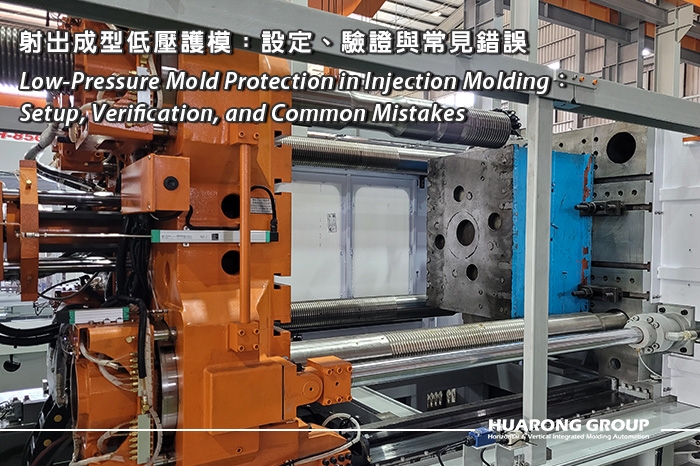
In the injection molding industry, molds are high-value and high-precision critical assets. Their structures typically include slides, ejector pins, angle pins, and complex cavity designs, making them highly sensitive to mechanical interference. Once an abnormality occurs during mold closing, it not only damages the mold itself but also disrupts production, increases downtime, affects delivery performance, and reduces overall production line efficiency, resulting in significant operational losses.
In practice, most mold damage occurs during the clamping and closing stage. Common causes include residual parts, slides or ejector pins not returning to position, and foreign objects on the parting surface. Low-pressure mold protection has therefore become a critical safety control mechanism. By performing mold closing under low speed and low pressure while monitoring resistance, the machine can stop immediately at the early stage of abnormality, effectively preventing high-energy collisions and ensuring mold safety and process stability.
Low-pressure mold protection is a safety control mechanism applied to the clamping system of injection molding machines. Its main function is to establish a controllable “low-energy monitoring zone” during mold closing, integrating hydraulic pressure, servo torque, and position feedback signals to detect abnormal resistance.
When the mold enters the low-pressure protection zone, the system automatically switches to safety control mode, reducing clamping speed and pressure so the mold approaches the parting surface in a controlled manner. If the system detects abnormal pressure increase or unexpected position changes, it identifies an abnormal condition and immediately stops clamping.
- Position control:Defines the safety monitoring zone
- Pressure control:Monitors resistance variation
- Speed control:Reduces inertia and impact energy
The key value of this mechanism lies in converting high-energy mechanical impact into detectable low-energy signal variations, enabling preventive protection before damage occurs.

Low-pressure mold protection is not a single parameter but a system composed of three interrelated control zones. Their proper configuration directly determines protection effectiveness and production stability.
The protection start position defines the critical point where mold closing switches from high speed to low-pressure monitoring mode. It is usually set in a safe zone before potential interference occurs. This parameter must be determined based on the mold structure rather than a fixed distance.
Common design principles include:
- Safe distance before guide pin contact
- Transition position before slide movement
- Allowance for machining tolerance and wear compensation
If set too early, it will extend cycle time; if set too late, protection may not activate in time.
The protection end position is the final control point for complete mold closing. It is usually set slightly above the actual parting surface contact position to avoid misjudgment caused by thermal expansion or mechanical errors.
In practice, a compensation of 0.1 to 0.3 mm is typically added to account for:
- Mold thermal expansion
- Long-term wear clearance changes
- Machine positioning repeatability error
Insufficient compensation leads to frequent false alarms, while excessive compensation reduces sensitivity.
Speed and pressure are the most critical dynamic control factors in the system, directly affecting the ability to detect abnormal resistance.
- Speed setting logic:Typically 10% – 15% of normal clamping speed to reduce inertia and ensure pressure reflects true mechanical resistance rather than kinetic energy.
- Pressure setting logic:Must be the minimum level that can complete mold closing. Too high allows foreign objects to be crushed; too low prevents proper closing.
A stepwise pressure reduction method is commonly used to determine the optimal setting.
| Parameter | Function | Engineering Purpose | Risk |
| Start Position | Activate monitoring zone | Enter safety mode early | Too early reduces efficiency |
| End Position | Complete mold closing control | Compensate for error and expansion | Overcompensation reduces sensitivity |
| Speed / Pressure | Core detection parameters | Establish low-energy monitoring | Imbalance leads to failure |
Low-pressure mold protection settings must follow a standardized engineering procedure to ensure consistency and repeatability across different machines and operators.
1. Inspect mold structure, ensuring slides, ejector pins, and mechanisms are fully reset, and no foreign objects remain.
2. Define the monitoring zone by setting start and end positions.
3. Reduce clamping speed in the low-pressure zone to minimize inertia.
4. Gradually reduce pressure to find the minimum stable closing point with protection capability and verify repeatedly.
Place paper on the mold surface:
- Machine stops → Protection effective
- Mold closes → Pressure too high
Use plastic or metal sheets:
- Test response to different thicknesses
- Verify sensitivity
- Perform multiple open-close cycles
- Confirm consistency
Analyze using sensors:
- Pressure curve changes
- Abnormal resistance points
- Detection consistency

Although low-pressure mold protection is a safety mechanism, improper settings can indirectly affect product quality.
| Issue | Cause | Impact |
| Excessive pressure | Protection failure | Mold damage |
| Excessive speed | High inertia | Detection inaccuracy |
| Late start position | Delayed protection | Mold collision |
| Unstable settings | Inconsistent operation | False alarms |
Low-pressure mold protection is a safety control mechanism of injection molding machines, whereas low-pressure molding is an encapsulation process technology; the two are completely different in purpose and application.
| Item | Low-Pressure Mold Protection | Low-Pressure Molding |
| Nature | Safety protection system | Processing technology |
| Function | Mold collision prevention | Product encapsulation |
| Pressure | Monitoring-level low pressure | Molding pressure |
| Material | General plastics | Hot-melt materials (PA) |
| Application | Injection molding machines | Electronic encapsulation |
Low-pressure mold protection has evolved from a basic machine function into a core system integrating mechanical safety and process risk control. Its value lies in coordinating position, speed, and pressure to establish a controllable and responsive safety boundary, enabling the system to stop before mold damage occurs. When properly standardized and stabilized, it effectively extends mold life, reduces downtime risk, and enhances overall production efficiency, making it an essential configuration in modern injection molding.
- Group Name: Huarong Group
- Brand: Huarong, Yuhdak, Nanrong
- Service Offerings: Injection Molding Machine, Vertical Injection Molding Machine, Injection Molding Automation
- Tel: +886-6-7956777
- Address: No.21-6, Zhongzhou, Chin An Vil., Xigang Dist., Tainan City 72351, Taiwan
- Official Website: https://www.huarong.com.tw/