Mold Opening Stroke and Thickness: A Guide to Opening Stroke vs Daylight
2026-03-19 14:22:43
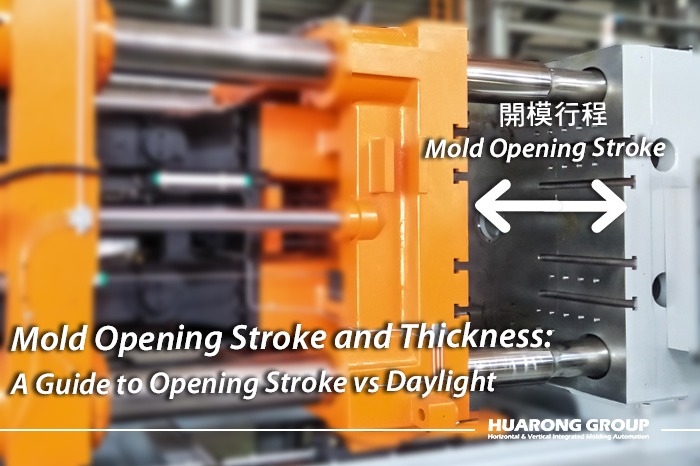
Mold Opening Stroke is the maximum distance the moving platen travels when the mold opens, determining how far the mold halves separate. This affects part release, robotic removal, and machine reliability in continuous production. For machine buyers, understanding this is key to ensuring compatibility, efficiency, and stability in modern plastic manufacturing.
Mold Opening Stroke is the maximum distance the moving platen travels to separate the mold halves. This parameter is vital for ensuring the molded part, runner, and robotic arms have enough clearance to exit the machine safely.
Mold Opening Stroke (also called opening stroke distance or platen travel distance) refers to the maximum distance the moving platen travels during mold opening on injection molding machines. The moving platen separates the mold halves after the plastic part has cooled and is ready for ejection.
In practical terms, this specification determines the available space between the mold halves during the open position.
The stroke must accommodate several physical elements inside the mold system:
- Product height
- Runner or sprue system
- Ejector stroke
- Safety clearance for part removal
- Space for robotic part handling
Injection molding machines include Mold Opening Stroke in their technical specification sheets, typically within the clamp unit section.

Mold Opening Stroke is not just a machine dimension; it directly affects real production conditions. When the stroke is properly selected, the molding cycle operates smoothly. When it is insufficient, production problems quickly appear.
After cooling, the mold must open far enough for ejector pins to push the part off the core.
What happens with insufficient stroke:
- Part collides with mold components
- Part remains stuck in the cavity
- Ejection failure stops production
Proper stroke ensures:
- Ejector pins push the part completely
- Molded product clears the core surface
- Parts fall freely or are ready for robotic removal
Modern injection molding factories rely heavily on robotic automation. Manipulator Arms require sufficient vertical or horizontal clearance to enter the mold area and remove the molded part.
If the Mold Opening Stroke is too short:
- Robots cannot access the cavity
- Production must rely on manual removal
- Automation efficiency decreases
Therefore, stroke requirements are often calculated based on both part dimensions and robot clearance requirements. Industrial robots typically require 100-200mm additional clearance, depending on gripper width
In injection molding machines, the Mold Opening Stroke cannot be considered independently. It must be evaluated together with another key parameter: Mold Thickness.
Mold Thickness defines the closed height of the mold between the fixed platen and moving platen. It refers to the total thickness of the mold when fully closed, including:
- cavity plate
- core plate
- support plates
- backing plates
- spacer blocks
Each injection molding machine defines a minimum and maximum mold thickness range.
Example of HRFC injection machine specification:
| Model Range | Mold Thickness (mm) |
|---|---|
| HRFC 100 | 100 – 360 |
| HRFC 200 | 130 – 520 |
| HRFC 400 | 200 – 700 |
| HRFC 800 | 300 – 1000 |
| HRFC 1000 | 380 – 1200 |
| HRFC 1400 | 450 – 1400 |
| HRFC 2000+ | 500 – 1500+ |
The starting position of the moving platen depends on Mold Thickness. When the mold is thicker, the mold halves begin closer together relative to the machine structure.
This means that the effective open distance is calculated using the relationship between:
- Mold Thickness
- Mold Opening Stroke
- Machine daylight
Therefore, engineers must evaluate these parameters together when selecting a machine.
Another important concept related to Mold Opening Stroke is Daylight, which is often misunderstood by new engineers or machine buyers.
Understanding the relationship between Opening Stroke vs Daylight is essential for ensuring machine compatibility with molds.
Daylight refers to the maximum distance between the fixed platen and moving platen when the mold is fully open.
In other words, it represents the total open space available inside the clamping unit.
The relationship between Opening Stroke vs Daylight can be expressed as:
This equation shows that the machine must provide enough total open space to accommodate both the mold and the opening distance required to remove the part.
For example: HRFC 1000
| Parameter | Value |
|---|---|
| Mold Thickness | 380 – 1200 mm |
| Mold Opening Stroke | 260 mm |
Maximum Daylight:
Daylight = Mold Thickness + Opening Stroke
Daylight = 1200 + 260 = 1460 mm
When selecting a machine for a mold, engineers must verify:
- Mold Thickness fits within machine limits
- Mold Opening Stroke is sufficient for part removal
- Total daylight is adequate
If daylight is insufficient, the mold cannot open fully even if the stroke specification appears adequate.
| Component | Typical Range | Notes |
|---|---|---|
| Product Height | 50-500 mm | Actual molded part dimension |
| Runner Height | 15-60 mm | Sprue system thickness |
| Ejector Stroke | 30-80 mm | Distance pins travel to eject part |
| Safety Clearance | 50-100 mm | Minimum safety margin |
| Robot Clearance | 0-200 mm | Only if using industrial automation |
Example 1: Small Container (Manual Ejection)
- Product: 120 mm | Runner: 30 mm | Ejector: 40 mm | Safety: 60 mm
- Required Stroke: 250 mm
- Machine Size: 120-200 ton (provides 300-550 mmàSufficient)
Example 2: Deep Container with Robotic Removal
- Product: 240 mm | Runner: 50 mm | Ejector: 60 mm | Safety: 80 mm | Robot: 150 mm
- Required Stroke: 580 mm
- Machine Size: 400 ton (provides 500-900 mm à Sufficient)
Example 3: Large Automotive Housing with Automation
- Product: 450 mm | Runner: 80 mm | Ejector: 100 mm | Safety: 100 mm | Robot: 200 mm
- Required Stroke: 930 mm
- Machine Size: 800-1000 ton (provides 900-1600 mm à Borderline - recommend 1000 ton)
Machine architecture significantly influences the available Mold Opening Stroke. Different clamp designs offer different stroke capacities.
Traditional injection molding machines typically use a three-platen toggle clamp design.
Characteristics include:
- compact machine footprint
- moderate opening stroke
- high clamp force efficiency
These machines are widely used for small to medium-size molded parts.

Related products: Injection Molding Machines – HRU & HRN Series
Two-platen machines are commonly used for large plastic products.
Their design offers several advantages related to Mold Opening Stroke:
- significantly longer opening stroke
- larger mold thickness capacity
- compact machine length relative to stroke
Because the tie bars move with the platen, two-platen machines allow larger molds and longer strokes without excessively increasing machine length.

Related products: Two platen injection molding machine – NRH series
When selecting an injection molding machine for a new mold, engineers typically evaluate several parameters in sequence.
Check that the mold fits within the tie-bar spacing of the machine.
Ensure the mold height falls within the machine’s minimum and maximum mold thickness specifications.
Use product height, runner height, and ejection requirements to determine the required stroke.
Confirm that the machine provides sufficient daylight to accommodate both Mold Thickness and Mold Opening Stroke.
Ensure the machine provides enough clamping force based on projected area and injection pressure.
Following these steps prevents costly installation issues and ensures stable production.
Mold Opening Stroke is one of the most critical specifications in injection molding machines because it determines whether molded parts can be safely released and whether automation can operate efficiently. When engineers evaluate Mold Opening Stroke, they must also consider Mold Thickness and understand the relationship between Opening Stroke vs Daylight. These three parameters together determine whether a mold can operate properly on a given machine.
By calculating the required opening stroke based on product geometry and verifying machine daylight capacity, manufacturers can avoid installation problems, protect molds from damage, and ensure efficient plastic part production in modern automated factories.
- Group Name: Huarong Group
- Brand: Huarong, Yuhdak, Nanrong
- Service Offerings: Injection Molding Machine, Vertical Injection Molding Machine, Injection Molding Automation
- Tel: +886-6-7956777
- Address: No.21-6, Zhongzhou, Chin An Vil., Xigang Dist., Tainan City 72351, Taiwan
- Official Website: https://www.huarong.com.tw/