


Two platen injection molding machine – NRH series
ー Low Shrinkage, Better Stability, with Lightweight and Cost Efficiency
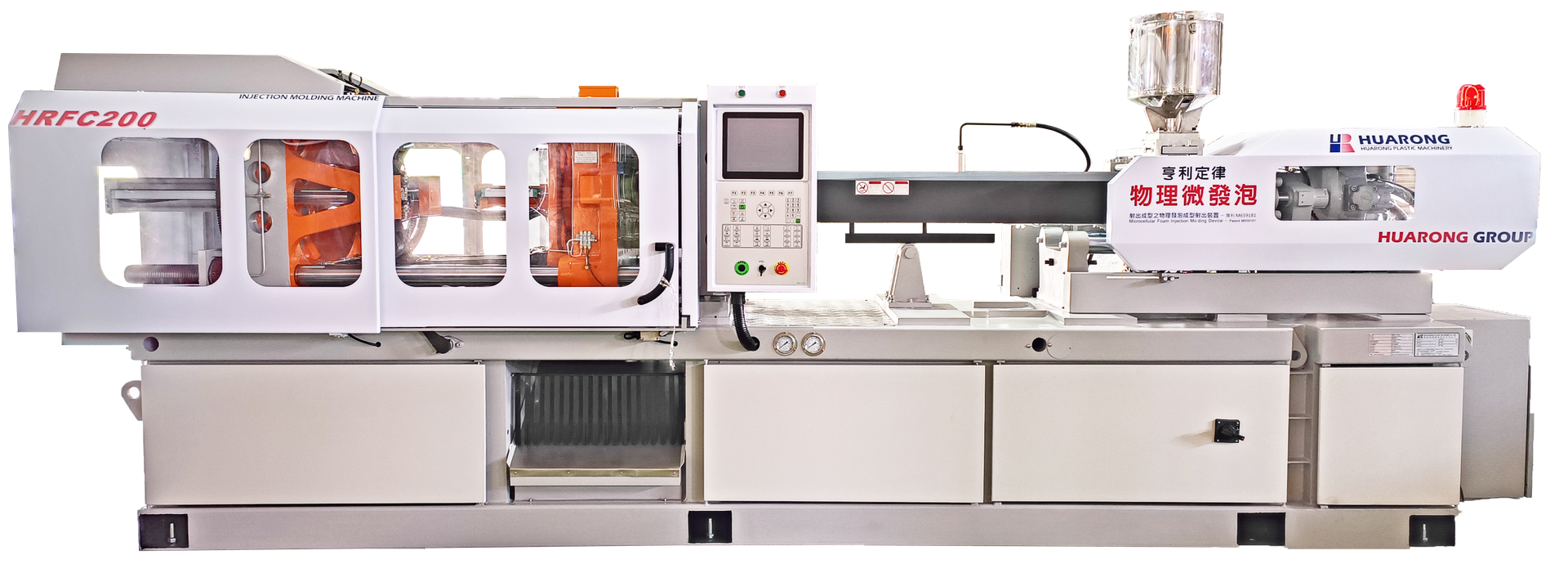
Key Features of Microcellular Foam Injection Molding Machine
Low Shrinkage and Better Dimensional Stability
The microcellular structure helps release internal stress during molding, reducing uneven shrinkage, warpage, and sink marks commonly seen in conventional solid injection molding.
This makes the technology particularly suitable for flat parts, large-area thin-wall components, and applications requiring tight dimensional control.


Patented Design (M659181)
Integrated with a dedicated barrel system, shut-off nozzle, and SCF injection configuration to help establish stable and repeatable foaming conditions.
15–20% Weight Reduction
Under the same part geometry, the microcellular structure enables weight reduction of approximately 15–20%, while material consumption per shot can be reduced by around 10–20%.
This is particularly valuable for high-volume functional plastic parts where material cost is a key factor.


Lower Clamp Force and Injection Pressure
With the formation of microcells inside the mold cavity, internal pressure is reduced. Clamp force can typically be reduced by approximately 30–50%, along with lower injection pressure.
This helps reduce long-term machine and mold load, and creates opportunities to evaluate lower tonnage machine configurations.
Reduced Holding Pressure and Shorter Cycle Time
Microcellular foam utilizes cell growth to partially replace conventional packing (holding pressure). In certain applications, holding pressure can be reduced or even eliminated.
This can shorten cycle time, improve production efficiency, and optimize machine utilization.


Compatible with Recycled Materials for Sustainability
Compared to chemical foaming processes, microcellular foam does not require chemical blowing agents and uses less material overall.
In selected applications, PCR (post-consumer recycled) materials can be evaluated. When viscosity and material stability are suitable, it supports waste reduction, lower material consumption, and improved ESG performance.
Performance Benefits of Microcellular Foam Injection Molding
Improved Dimensional Stability
Prioritizes improvement in shrinkage, warpage, and sink mark issues, making it suitable for flat parts, large-area components, and high-precision functional applications.
Weight Reduction and Material Saving
Product weight can be reduced by approximately 15–20%, while material consumption per shot can be reduced by around 10–20%, providing clear cost advantages in mass production.
Reduced Machine Load
Clamp force can be reduced by approximately 30–50%, along with lower injection pressure, helping reduce equipment wear and long-term maintenance requirements.
Application Industries
Microcellular foam injection molding is particularly suitable for plastic products that require dimensional stability, lightweight design, and material efficiency:
- Automotive components: instrument panel structures, door trim, structural supports
- Consumer electronics: laptop housings, tablet back covers, structural parts
- Sports equipment and transportation plastic parts Industrial and functional plastic components
- Packaging applications and selected thin-wall containers
Equipment Requirements and Implementation Conditions
SCF Supply and Metering System
Stable nitrogen or CO₂ supply combined with precise metering and control modules.
Specialized Plasticizing Unit
Requires screw and barrel design capable of dissolving supercritical fluid into molten resin
Shut-off Nozzle
Prevents SCF leakage before injection and is essential for maintaining stable foaming conditions.
Process Integration Capability
Successful implementation requires integrated evaluation of mold design, material selection, processing parameters, and mass production validation.
Common Material Options
Material selection for microcellular foam molding must consider cell uniformity, mechanical performance, surface requirements, and production stability. Common materials include:
- PP: good foaming capability, widely used in automotive and consumer products
- PC / ABS: suitable for electronic housings and structural parts, requires evaluation of foaming ratio
- PA (Nylon): glass fiber reinforced grades commonly used in automotive and industrial parts
- Glass fiber reinforced materials: improve stiffness and dimensional stability, requires evaluation of fiber distribution
- PCR recycled materials: can be evaluated for certain applications, subject to viscosity and quality consistency
Limitations and Considerations
Microcellular foam technology is not suitable for all products. The following conditions should be carefully evaluated:
- High appearance requirement parts: may show silver marks, flow marks, or reduced surface gloss
- High transparency parts: microcellular structure affects optical clarity
- High strength requirement parts: when foaming ratio is within 15%, strength may be maintained under proper design; above 15%, structural validation is recommended
- Low-volume or low-budget projects: higher implementation cost may not be suitable for small-scale production
Why Choose Huarong Microcellular Foam Injection Molding Machine
40+ Years of Manufacturing Experience
Huarong, Yuhdak, and Nanrong brands cover a full range of horizontal, vertical, and multi-component machines.
Technology Integration Capability
Provides SCF system integration, process implementation support, and machine configuration, not just standalone equipment.
Application Evaluation Support
Supports feasibility evaluation based on product requirements, material, mold design, and production conditions.
Automation and Smart Manufacturing Integration
Can integrate with automation peripherals and smart factory systems to support factory upgrades and turnkey solutions.
Further Reading
To learn more about the principles, equipment requirements, applications, and evaluation considerations of microcellular foam injection molding, please refer to our complete technical guide.
