


Automotive Lighting Case:Stable Production of Car Lights & Transparent Parts
2026-05-28 09:15:31
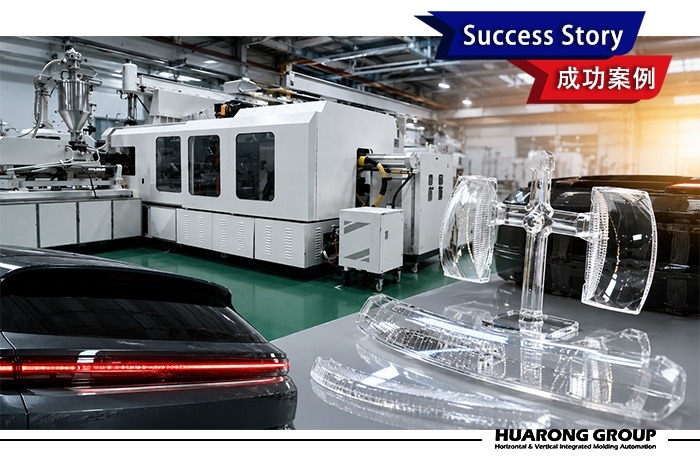
For automotive electronic component manufacturers, automotive lighting injection molding machines are not just production equipment, but the core foundation that directly affects lamp appearance, transparent part quality, dimensional stability, and delivery capability. The client in this case is a well-known automotive electronics technology company in Mainland China, specializing in automotive lighting systems, electronic control modules, interior and exterior plastic components, and precision mold development. As China's new energy vehicle market continues to expand, the client has placed higher demands on the stability, precision, and versatile molding capabilities of injection molding equipment. Through conventional injection molding machines, dual-shot injection molding machines, triple-shot injection molding machines, and large two-platen injection molding machines, HuaRong has helped the client support mass production requirements across different product lines.
The client in this case is a representative automotive electronic component manufacturer in Mainland China, mainly producing automotive lighting systems, interior and exterior body parts, electronic control modules, and related plastic structural components. As Chinese new energy vehicle brands continue to grow rapidly, including BYD, Li Auto, NIO, XPENG, AITO, Leapmotor, Xiaomi Auto, ZEEKR, GAC Aion, Deepal, and Geely Galaxy, these brands are continuously driving upgrades in automotive lighting design, intelligent lighting systems, and vehicle exterior styling. As a result, automotive parts suppliers are also required to achieve faster product development cycles and more stable mass production capabilities.

The client’s brand philosophy can be summarized as “One Side Technology, One Side Art.” Automotive lighting is no longer just a functional lighting component, but an essential part of a vehicle’s design language. Headlights, full-width taillights, dynamic turn signals, interior ambient lighting, and transparent light guide components all require the integration of electronic technology, optical design, mold capabilities, and high-quality injection molding processes.

For this type of customer, the value of an injection molding machine goes far beyond simply molding plastic. More importantly, it lies in the machine's ability to consistently control pressure, injection speed, temperature, clamping force, and holding pressure conditions throughout mass production. If the equipment lacks stability, automotive lighting products may develop defects such as sink marks, bubbles, short shots, flash, color variation, dimensional deviation, or optical deformation, which can further affect subsequent assembly, airtightness testing, and appearance inspection.
The client's main products include automotive headlights, rear combination taillights, interior ambient lighting, fog lamps, high-mounted brake lights, transparent light guide components, body trim strips, front grilles, bumper-related plastic parts, and housings for automotive electronic control modules. These products cover small precision components, medium-to-large exterior parts, multi-color molded products, and thick-wall transparent components, making it impossible to rely on a single machine model to fulfill all production requirements.
Among these applications, the“thick transparent parts”mentioned by the client can be understood in the automotive industry as thick-wall optical components, light guide pillars, optical lenses, transparent lamp covers, transparent vehicle emblems, welcome light guide components, or interior ambient light guide elements. These products are highly sensitive to material drying, melt uniformity, mold temperature, holding pressure profiles, and cooling control. As a result, they require highly stable injection molding machines as the foundation for reliable mass production.

As the client's production demand continued to expand, multiple manufacturing plants gradually introduced Huarong injection molding machines into their production lines. The purchased machine lineup included small conventional injection molding machines, dual-shot injection molding machines, Tri-injection molding machines, and large two-platen injection molding machines for the production of automotive lighting systems, automotive exterior parts, electronic component housings, and thick-wall transparent components.
Automotive electronic components come in a wide variety of types, with significant differences in size, materials, appearance, and functional requirements. Small electronic parts require highly stable repeatability and precision, while large exterior components demand sufficient platen space and clamping rigidity. Automotive lighting components, on the other hand, require excellent appearance quality, transparency, and dimensional stability. If the production line relies on only one type of equipment, limitations can easily arise in mold configuration, injection capacity, mold opening stroke, or multi-color molding capability.
Huarong offers a complete range of injection molding machine product lines, allowing suitable equipment configurations based on different product requirements. For automotive electronics manufacturers, this level of product integration helps reduce management costs when introducing equipment across multiple factories. It also enables on-site engineers to establish consistent operating logic in machine operation, maintenance, parameter settings, and troubleshooting.
Further Reading:Injection Molding Machine Manufacturer Profile - HUARONG GROUP
The design of automotive lighting and exterior components is placing increasing emphasis on brand recognition and functional integration. Dual-shot and triple-shot molding technologies allow customers to integrate transparent areas, blackout sections, decorative elements, and structural components into a single molding process, reducing the instability risks associated with secondary assembly and post-processing operations.
In automotive lighting products, the value of multi-shot molding goes beyond visual differentiation. It also improves dimensional accuracy, bonding strength, and production efficiency. Processes that previously required separate molding, assembly, lamination, or adhesive bonding could easily lead to tolerance accumulation, adhesive overflow, positioning deviation, or inconsistent appearance. By utilizing dual-shot or triple-shot injection molding machines, customers can achieve greater structural integration directly within the mold, significantly improving mass production consistency.

In this case, Huarong did not provide a single standalone machine, but instead delivered a complete injection molding machine product portfolio to support the client's long-term capacity expansion. The client's continuous adoption of HuaRong equipment across multiple production sites demonstrates a high level of trust in machine stability, product quality, and after-sales support.
Small standard injection molding machines are primarily used for automotive electronic control module housings, small brackets, mounting bases, connectors, interior small parts, and peripheral plastic components for electronic control systems. Although these parts are relatively small in size, they require strict control over flash formation, assembly precision, dimensional stability, and long-term continuous production capability.
When short shots occur, it is typically necessary to inspect melt temperature, injection speed, injection pressure, gate design, venting conditions, and the injection-to-holding pressure switch-over position. If flash occurs, it is often related to insufficient clamping force, mold parting line wear, excessive injection pressure, or mold fit clearance issues. HuaRong equipment, with its stable injection control system and robust clamping structure, helps customers establish more consistent and stable molding conditions.
Recommended Machines:Servo Injection Molding Machines – HRS & HRFC Series
Dual-shot and triple-shot injection molding machines are widely used in multi-color decorative lighting components, transparent and opaque material combination parts, light guide and structurally integrated components, as well as automotive interior and exterior parts that require a strong visual identity. The key factors for these products include injection sequence control, rotary platen positioning accuracy, overmolding stability in the second shot, material compatibility, and mold temperature balance.

If the injection speed is unstable, it may result in flow marks, water marks, or inconsistent weld line positions. Insufficient holding pressure may lead to sink marks or excessive dimensional shrinkage. If the temperature conditions between the first and second shots are not properly matched, it may also affect bonding strength and surface appearance quality. HuaRong multi-shot systems help customers maintain a more stable processing window for complex products.
Recommended Machine:Double Injection Molding Machine – HDC Series
Large two-platen injection molding machines are well-suited for large automotive structural lighting parts, bumper-related components, front grilles, body trim strips, and oversized transparent parts. The two-platen structure offers strong adaptability for large molds, supporting wider platen space and longer mold opening strokes, which provide practical advantages in the production of automotive exterior components and large-scale tooling applications.
Thick-wall transparent parts represent one of the more technically challenging applications in this category. If material drying is insufficient, bubbles and silver streaks may occur. If the mold temperature is uneven, internal stress, haze, or warpage may develop. If the injection speed is too high, shear marks and optical distortion may appear. If the holding pressure profile is unstable, it may result in sink marks and dimensional inconsistency. Through stable injection pressure control, precise temperature management, and optimized holding pressure regulation, customers can significantly improve the production stability of thick-wall transparent components.
Recommended Machine::Two platen injection molding machine – NRH series
The client in this case already possesses a highly mature manufacturing management system. Each visit to the production facility clearly reflects the image of an internationally oriented manufacturing enterprise. The production floor is spacious and well-lit, with clear workflow layouts and organized material flow. Equipment operates continuously and stably, output levels remain consistently sufficient, and the overall management standard strongly demonstrates the company’s strict requirements for both quality and efficiency.
Mass production of automotive components is not only about speed, but more importantly, about consistent cycle time. If the injection molding cycle fluctuates between fast and slow, it will directly affect capacity planning, downstream assembly scheduling, and overall delivery commitments. After adopting Huarong equipment, the client is able to maintain stable cycle performance in the production of automotive lighting systems, transparent components, and exterior automotive parts, providing practical advantages for large-volume orders and multi-product scheduling.
The injection molding cycle is typically influenced by plastication time, injection time, holding pressure time, cooling time, mold opening/closing speed, ejection time, and part removal method. For thick-wall transparent components, cooling and holding pressure are the most critical factors. For multi-shot automotive lighting parts, rotary platen positioning, injection sequence control, and secondary molding cycle timing directly impact overall production efficiency.
High production yield is not achieved by the injection molding machine alone, but rather through the combined effect of equipment, mold design, material handling, drying conditions, mold temperature control, process parameter settings, and on-site management. The client in this case also possesses strong in-house precision mold development capabilities, allowing considerations such as gate location, venting design, cooling efficiency, material shrinkage, and dimensional compensation to be incorporated at the early product design stage. When mature mold engineering is paired with a stable injection molding platform, the probability of successful mass production increases significantly.
The client's high level of satisfaction with Huarong equipment comes from long-term, real-world production experience. Across multiple manufacturing sites, the continued adoption of HuaRong injection molding machines demonstrates that the equipment consistently meets the practical requirements of automotive electronic component manufacturers in terms of stability, ease of operation, maintenance support, and mass production reliability.
Automotive lighting and optical transparent components are highly sensitive to molding conditions. If the injection molding machine lacks repeatability, even with well-designed molds, quality fluctuations may still occur during long-term mass production. Therefore, a stable injection molding system for automotive lighting must be capable of supporting precise control over pressure, speed, temperature, position, and timing on the production floor.
For automotive lighting and transparent components, critical molding parameters include barrel temperature, mold temperature, injection speed, injection pressure, holding pressure, holding time, back pressure, screw speed, switchover position, and cooling time. When processing transparent materials, if the melt temperature is too low, it may cause flow marks and incomplete filling. If the melt temperature is too high, it can lead to material degradation and yellowing. Excessively high injection speed may result in shear marks, while insufficient speed can cause cold flow lines and more visible weld lines.
Therefore, on-site parameter setup should not only focus on whether the part is filled, but also evaluate part weight, dimensional accuracy, transparency, stress marks, surface appearance, and final assembly performance. For automotive component manufacturing, long-term repeatability is far more critical than achieving a single successful molding cycle.
For automotive exterior components and structural lighting parts, dimensional instability or warpage is often caused by factors such as uneven wall thickness, inconsistent mold cooling, insufficient holding pressure, suboptimal gate location, unbalanced ejection, or differences in material shrinkage direction. In large-scale parts, additional attention must be paid to platen rigidity and mold support; otherwise, long-term production may lead to uneven stress on the parting line, further affecting flash formation and dimensional consistency.
Huarong provides machine selection support based on product size, mold weight, material characteristics, and injection capacity requirements. When the machine operates stably, the mold is properly designed, materials are sufficiently dried, and mold temperature control is consistent, both dimensional accuracy and surface quality of the final product can be maintained within a more controllable range.
Automotive component manufacturing is typically characterized by continuous production cycles, high accountability, and long-term supply commitments. For customers, stable machine operation is therefore more important than short-term procurement cost. If a machine experiences unexpected downtime, it not only affects daily output but may also disrupt downstream assembly schedules, shipment planning, and even OEM delivery timelines.
Injection molding machine maintenance should include periodic inspections of the hydraulic system, lubrication system, heating elements, thermocouples, screw and barrel assembly, clamping mechanism, electrical control system, safety devices, and cooling water circuits. For transparent components and automotive lighting exterior parts, heating stability, screw barrel condition, and material drying are particularly critical, as any temperature fluctuation, material retention, or screw wear can be directly reflected in product appearance quality.
HuaRong provides maintenance recommendations tailored to different machine models and on-site operating conditions, along with spare parts supply and after-sales service support. When customers operate HuaRong machines across multiple production sites, standardized maintenance procedures help reduce servicing complexity and improve overall equipment management efficiency.
Issues in injection molding production are not always caused by the machine itself. They may also be related to material batch variations, mold conditions, cooling channel performance, drying efficiency, ambient temperature, or changes in processing parameters. HuaRong assists customers in tracing root causes from molding defects back to their origin. For example, short shots typically require evaluation of filling capability and venting conditions; flash issues point to clamping force and parting line conditions; bubbles are often linked to drying and holding pressure; and flow marks may require checks on melt temperature, mold temperature, and injection speed.
This type of technical support is especially important for automotive electronic component manufacturers, as quality issues in automotive products cannot be judged solely by surface appearance. Instead, they must be analyzed through a comprehensive evaluation of product design, mold structure, material characteristics, and injection molding conditions.
H2:案例價值:高品質客戶選擇穩定可靠的射出成型設備
本案例最具代表性的地方,在於客戶不是單次採購華嶸設備,而是在不同廠區、不同產品線中持續使用華嶸射出機。從小型一般射出機到雙射、三射,再到大型兩板式射出成型機,華嶸完整產品線支援了客戶從汽車電子零件到車燈照明系統與大型外飾件的多元製造需求。
H3:長期採用代表量產後的信任
該客戶本身產品品質優良,工廠管理成熟,現場生產有序,具備汽車零件供應鏈所需的專業條件。能讓這樣的客戶長期採用華嶸設備,代表華嶸射出成型機能符合汽車產業對精密度、穩定性、效率與服務支援的要求。
對正在尋找汽車車燈射出成型機、汽車零件射出成型機、雙射射出機、三射射出機或兩板式射出成型機的製造商而言,本案例說明設備選型不應只比較噸數與價格,更應確認供應商是否具備完整機型、汽車零件經驗、多射成型能力、大型機台能力與長期服務支援。
H2:結論:汽車電子零件製造,需要能陪伴客戶成長的射出成型夥伴
隨著新能源車、智慧照明、車身美學與電子控制技術持續發展,汽車零件供應商面對的挑戰不只是產能增加,也包含產品複雜度提高、外觀標準提升、尺寸要求更嚴格與交期壓力更集中。對這類客戶而言,穩定可靠的汽車車燈射出成型機,是支撐長期競爭力的重要設備基礎。
華嶸透過一般射出機、雙射射出機、三射射出機與大型兩板式射出成型機,協助中國大陸汽車電子零件製造商穩定生產車燈照明系統、汽車內外飾件與厚壁透明光學件。這不只是一個設備採購案例,更是一個關於穩定量產、品質信任與長期合作的客戶案例。
當製造商需要面對更高品質標準、更大產能需求與更複雜的汽車零件開發時,華嶸能提供的不只是射出成型機,而是能與客戶產品、模具、材料、製程與未來擴廠計畫配合的長期成型解決方案。