


Microcellular vs Structural Foaming: Dimensional Stability & Surface Comparison
2026-04-10 13:14:19
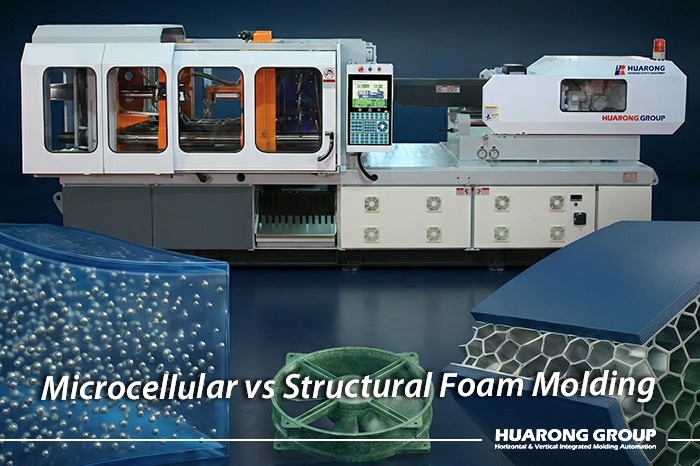
In numerous industries, lightweighting is now a key engineering goal linked to resin costs, energy use, dimensional stability, and sustainability. Consequently, more manufacturers are considering foaming technologies not just to cut part weight but also as a strategic process decision.
Microcellular foaming can reduce part weight by 15–20% with ±0.2–0.5% tolerances, while structural foam targets thicker parts with coarser cells. They differ in cell morphology, wall thickness, surface finish, process control, and ideal applications
For engineers, molders, and project decision-makers, the real question is not which technology is more advanced in general. The better question is this: which foaming method matches the part function, tolerance requirements, and production goals of your application? That is where a direct technical comparison becomes useful.
This article provides a deep benchmark between microcellular foaming and structural foaming, with a focus on lightweight injection molding, recycled material processing, and process suitability for modern manufacturing. Huarong’s current technical positioning around microcellular foam injection molding, including its Chinaplas 2026 showcase at Booth 1.1D42, reflects that direction.
The short answer is that microcellular foaming is a fine-cell, precision-oriented foaming process, while structural foaming is a coarse-cell, thick-wall process designed mainly for stiffness and part-scale efficiency.
Microcellular foaming typically uses supercritical nitrogen or carbon dioxide dissolved into the polymer melt. When pressure drops during injection, a very large number of micro-scale cells nucleate throughout the part. The result is a more uniform internal structure, lower part density, reduced shrinkage pressure, and improved dimensional stability when the process is tuned correctly. Huarong’s current technical article describes this as a physical foaming method using supercritical gas, typically nitrogen or carbon dioxide, to form a uniform foam structure during molding.
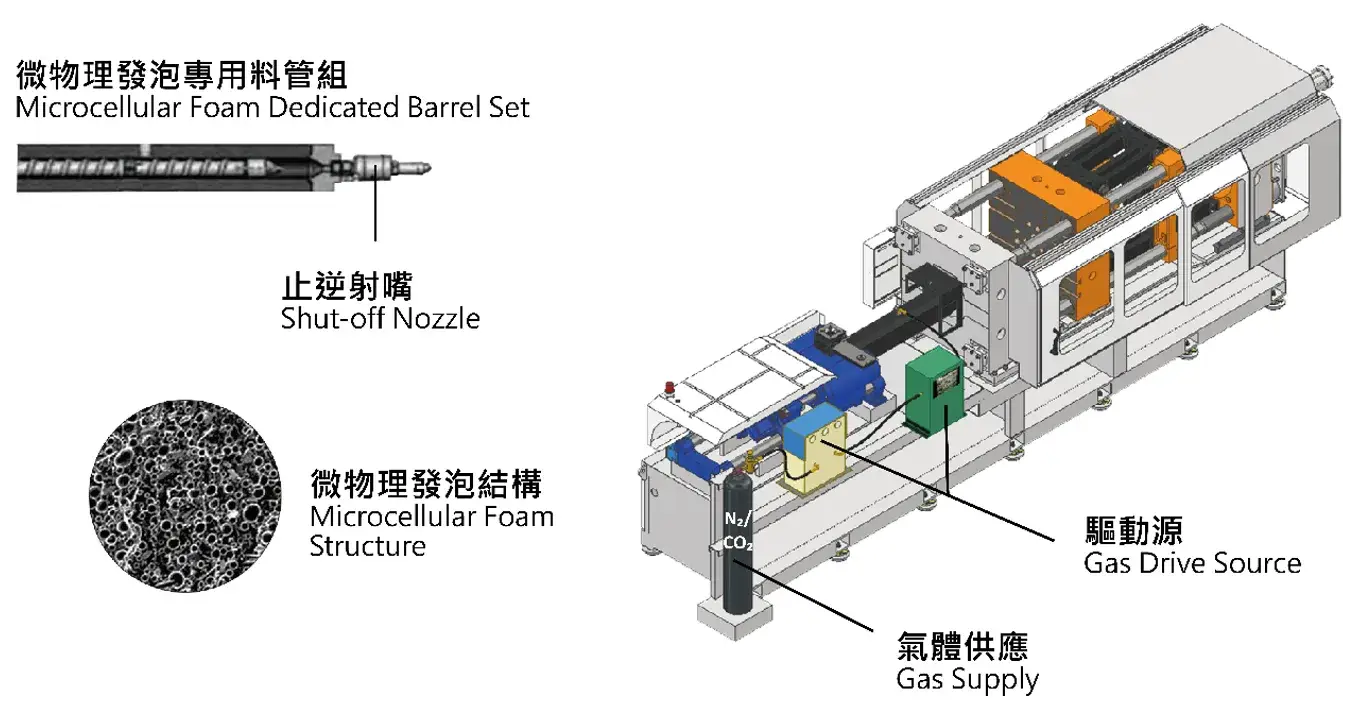
Structural foaming, by contrast, generally produces a much larger internal cell structure and a more obvious skin-core morphology. It is commonly used for thicker parts where surface finish is not the highest priority, but stiffness-to-weight ratio and material efficiency are important. In practice, structural foam is often associated with large molded products such as pallets, panels, housings, and other thick-section industrial parts.

In other words, if the application requires tighter tolerances, thinner walls, better appearance control, and more stable part geometry, microcellular foaming is usually the more suitable engineering direction. If the application is large, thick, and structurally driven, structural foaming may be the more practical choice.
Many discussions about foaming still focus only on weight reduction. That is too narrow. In actual production, the selection between microcellular foaming and structural foaming influences several real manufacturing outcomes:
- required clamping force
- injection pressure profile
- cooling behavior
- moldability of recycled materials
- surface appearance
- secondary finishing needs
- dimensional consistency from shot to shot
For example, our microcellular foaming article emphasizes that physical foaming is not only about making a part lighter. It also reduces holding demand, lowers clamping force, shortens cycle time, and improves dimensional stability in suitable parts.
That point is important because many processors today are under pressure from resin costs, carbon-reduction targets, machine energy consumption, and product-quality demands. A foaming process that reduces mass but creates unstable dimensions may not solve the real production problem. Likewise, a process that delivers rigidity in a thick structural part may be excellent for one category of application and completely unsuitable for another.
Further reading: Microcellular Foam Injection Molding: A Complete Guide to Lightweight and Energy-Efficient Production
The most fundamental difference begins at the internal morphology level.
Microcellular foaming typically forms very small, relatively uniform closed cells, often described as being in the microscale range. Because the cells are smaller and more evenly distributed, the part's internal stress state can be more balanced than in a conventional solid part, especially where packing pressure would otherwise cause shrinkage gradients or warpage. The uploaded benchmark draft characterizes microcellular foaming as having a uniform closed-cell structure and links that to stress reduction and dimensional stability.
In engineering terms, this more uniform morphology is one reason microcellular foaming is often considered for parts where the objective is not only lightweighting, but also reduced sink, reduced distortion, and more stable part geometry.
Structural foaming generally produces a larger, coarser internal cell structure with a clear outer skin and foamed core. The dense skin helps preserve part shape and outer integrity, while the expanded core improves section stiffness without requiring a fully solid thick wall. The uploaded benchmark draft describes this as a distinct skin-core structure with a coarse cellular interior.
This morphology is highly useful in thick parts, but it is also one reason structural foam is less often selected for applications requiring tight surface standards or fine dimensional control.
Part geometry is one of the fastest ways to determine which process is more realistic.
Microcellular foaming is generally better suited to thin- to medium-wall applications, especially when the processor aims to preserve functional performance while reducing weight and lowering molding pressure. The comparison draft places it in a thinner wall thickness range than structural foaming and associates it with precision-oriented molding.
Structural foaming is more naturally suited to thicker-walled parts, where core expansion provides section efficiency and stiffness. In such applications, the process can reduce material consumption compared with a fully solid thick part while maintaining sufficient structural integrity for industrial use.
This is why the two technologies often serve very different product categories. Microcellular foaming is more often evaluated for automotive interior parts, electronics housings, appliance components, and selected technical parts. Structural foaming is more often considered for pallets, crates, large panels, and industrial components where cosmetics are secondary to rigidity and scale.
Surface outcome is another major dividing line.
Microcellular foaming can still deliver a commercially acceptable appearance for many molded parts, but it may show mild visual effects depending on resin, tool design, and process settings. Huarong’s technical article notes that visible high-gloss requirements should be judged carefully, and that a matte or satin-like finish may be more typical in some microcellular foam applications.
Structural foaming, on the other hand, is typically less favorable when the product requires a refined cosmetic surface. Because of its larger cell structure and process behavior, it more commonly results in a rougher appearance and may require secondary finishing if aesthetics matter. The uploaded benchmark draft explicitly places structural foam at a lower level of surface quality than microcellular foaming.
From a design review perspective, this means surface expectations should be addressed early. If the part is customer-facing, dimension-sensitive, or aesthetically important, microcellular foaming usually deserves more serious consideration than structural foaming.
For many technical molders, the real advantage of microcellular foaming is not the weight reduction itself. It is the potential to improve dimensional behavior.
Huarong’s microcellular foaming article repeatedly positions the process as a route to lighter parts with excellent dimensional stability and lower dependence on heavy packing conditions. It also explains that the internal packing effect created by cell nucleation can reduce the need for conventional holding pressure.
That is significant because many molded-part issues, including sink, warpage, and local deformation, are tied to how pressure, cooling, and material contraction interact within the cavity. A well-controlled microcellular structure can help redistribute these effects more evenly.
Structural foaming can still provide useful performance in large parts, but its process priority is usually different. It is often selected because it offers high stiffness at a lower overall density, not because it provides the tightest dimensional control. The uploaded benchmark draft identifies structural foaming as more structurally focused, while assigning higher dimensional stability performance to microcellular foaming.
For lightweight parts where geometry matters, that difference is often decisive.
Both technologies can reduce pressure-related demands compared with conventional solid molding, but they do so in different ways and for different part categories.
Huarong’s technical content on microcellular foam injection molding explains that the foaming action can reduce the required clamping force and lower the demand for holding pressure, which in turn can shorten cycle time and reduce energy use. It also states that manufacturers can sometimes use smaller machines for suitable parts because the process runs with lower cavity pressure than conventional solid molding.
The uploaded benchmark draft further frames microcellular foaming as a process that can reduce clamping force by roughly 30% to 50% and shorten cycle time when the part and process window are suitable. Structural foaming is described as operating at very low pressure, but more often in thicker-wall parts that still require longer cooling cycles.
This leads to an important engineering point. Lower pressure alone does not automatically mean higher total productivity. A thick structural foam part may run at low pressure but still be limited by cooling time. A microcellular part, by contrast, may benefit from both reduced pressure demand and shorter holding behavior, making it attractive where production efficiency matters as much as part weight.
One of the most strategically important sections is the discussion of 100% recycled material.
Recycled resins may suffer from variability in melt flow behavior and molecular weight distribution, and that supercritical gas can improve processability by reducing melt viscosity and improving flow consistency. It also notes that this can help processors reduce thermal stress on the resin and improve filling stability in more demanding geometries.
This is highly relevant to current market conditions. As more manufacturers are asked to increase PCR or PIR usage, the real challenge is often not just sourcing recycled resin. It is maintaining stable production and acceptable part performance while dealing with batch variation.
Huarong’s Chinaplas 2026 exhibition news directly connects microcellular foaming with this issue. The company states that its microcellular foam injection molding machine will produce a fan cover using 100% recycled material at Booth 1.1D42, specifically to demonstrate how the process can support material efficiency and sustainable production. The same exhibition article also frames this showcase as one of Huarong’s key technical highlights for the show.
A lightweight part is only useful if it still performs its intended function.
Microcellular foaming often improves the specific performance of the part, meaning the strength-to-weight relationship can remain highly competitive even when total mass is reduced. Your draft also notes that microcells can help absorb energy and interrupt crack propagation in recycled material systems, which is especially relevant where recycled resin brittleness is a concern.
That does not mean every microcellular part will outperform a solid part in every absolute mechanical metric. The engineering target should be more precise: reduce unnecessary mass while maintaining required functional performance.
Structural foaming, meanwhile, remains strong in applications where designers want a high stiffness-to-weight ratio in thicker sections. That is why it continues to be useful in industrial products and large molded structures. The right choice depends on whether the part is governed mainly by rigidity, precision, appearance, impact behavior, or dimensional control.
A practical selection guide looks like this.
- the part requires better dimensional stability
- the wall thickness is thin to medium rather than heavy structural section
- the application benefits from lower clamping force and reduced holding
- the processor wants cleaner physical foaming without chemical residues
- recycled material consistency is a current challenge
- the product needs a better surface outcome than typical structural foam can provide
- the part is large and thick
- stiffness is more important than fine cosmetic quality
- dimensional precision is moderate rather than highly demanding
- the product category includes industrial crates, pallets, large housings, or thick panels
- the value case is based on section efficiency rather than precision lightweighting
The increased attention on microcellular foaming is not happening for only one reason. It sits at the intersection of several manufacturing priorities:
- lower resin consumption
- lighter part design
- recycled material adoption
- energy reduction
- practical ESG-linked process improvement
- better dimensional control than older, coarser foaming methods
Huarong’s current positioning around microcellular foaming is not simply that it is a lightweighting technology. Its public technical content emphasizes a wider process value:
- lower clamping force
- reduced holding demand
- shorter cycle time potential
- better dimensional stability
- suitability for modern sustainability-oriented manufacturing
- compatibility with actual injection molding production needs rather than laboratory-only scenarios
Huarong’s microcellular foaming technology is positioned not only as a lightweighting solution, but also as a practical process improvement for manufacturers seeking lower clamping force, reduced holding demand, shorter cycle time potential, better dimensional stability, and improved suitability for sustainability-oriented production.
Huarong will also showcase its microcellular foaming technology at Chinaplas 2026, and we warmly welcome visitors to stop by and explore this technology in person.

Further reading: Chinaplas 2026: Huarong Showcases Injection Molding Solutions at Booth 1.1D42
Microcellular foaming and structural foaming are both valid lightweighting technologies, but they solve different engineering problems.
If the goal is to produce large, thick, rigid parts where appearance is secondary and structural efficiency is the main objective, structural foaming remains a practical and established choice.
If the goal is to achieve precision lightweighting, better dimensional stability, lower clamping force, cleaner physical foaming, and improved processing flexibility for modern materials including recycled resin, microcellular foaming is often the stronger technical route.
That is why more manufacturers are now evaluating microcellular foaming not just as a specialty process, but as a serious production technology for the next stage of lightweight and sustainability-driven injection molding. Based on Huarong’s published technical content and Chinaplas 2026 exhibition direction, this is also clearly the area the company is choosing to emphasize in 2026.
- Group Name: Huarong Group
- Brand: Huarong, Yuhdak, Nanrong
- Service Offerings: Injection Molding Machine, Vertical Injection Molding Machine, Injection Molding Automation
- Tel: +886-6-7956777
- Address: No.21-6, Zhongzhou, Chin An Vil., Xigang Dist., Tainan City 72351, Taiwan
- Official Website: https://www.huarong.com.tw/

No. Both are foaming technologies, but microcellular foaming uses a much finer and more uniform cell structure, while structural foaming typically creates a coarser skin-core structure for thicker parts. They are used for different engineering targets.
In general, microcellular foaming is more suitable when dimensional stability is a major requirement. Structural foaming is more commonly selected for thick structural parts where stiffness matters more than precision geometry.
Yes. Your comparison draft and Huarong’s Chinaplas 2026 exhibition plan both connect microcellular foaming with recycled-material processing, including a public demonstration using 100% recycled material.
Not automatically. Structural foaming may reduce material use in thick parts, but overall cost depends on tool design, cycle time, surface requirements, finishing needs, and the actual functional target of the part.
Because it addresses several current manufacturing priorities at the same time: lightweighting, lower resin usage, process efficiency, recycled material use, and sustainability-focused production improvement.