Dual-Shot Injection Molding & Automated Production Line for Automotive Lamp Lens
2026-03-26 08:51:58
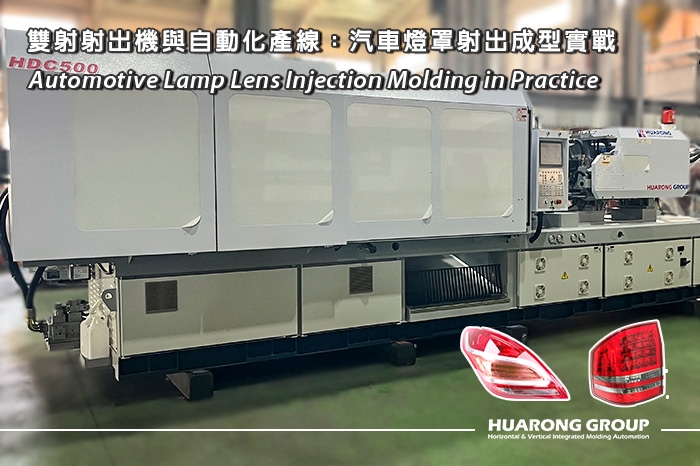
With the increasing demands of automotive design for appearance and functionality, dual-color or multi-material automotive lamp lens molding has become a key challenge in production lines. From transparent lamp lenses and colored reflectors to functional lighting components, every detail may affect overall vehicle quality and user experience. Although traditional single-color injection molding enables rapid production startup, it often fails to meet high-end automotive standards in color consistency, optical performance, and long-term operational stability. Therefore, customers choose to implement professional dual-shot injection molding machines and automated part removal systems to establish dedicated high-precision automotive lamp lens production lines.
Automotive lamp lenses are precision components integrating optical performance, aesthetics, and functionality. The molding challenges can be explained by the following four aspects:
| Challenge Category | Detailed Description | Impact on Final Product |
| High-speed continuous injection stability | In multi-cavity molds and high-cycle production, fluctuations in injection pressure or injection speed may cause short shots, bubbles, or uneven thickness | Reduced optical transparency, uneven color, bubbles or fine marks on the lens surface |
| Dual-shot molding precision | Transparent and colored materials must be molded in one cycle; inaccurate rotary platen positioning may cause color misalignment | Blurred color boundary, appearance defects, affecting automotive lighting brand image |
| Optical and appearance consistency | Optical transparent parts require high refractive index consistency and surface smoothness | Light spots, bubbles, or flow marks affecting light refraction and unstable light transmittance |
| Long-term operation reliability | Production lines require 24-hour continuous operation; insufficient machine durability or parameter stability | Increased downtime risk, reduced yield rate, affecting overall delivery schedule |
The challenges of lamp lens injection molding arise not only from molds or materials, but also from injection machine precision and production line automation capability. Optically transparent parts require extremely high refractive index uniformity, while colored reflectors or decorative lines must maintain precise color boundaries. These requirements impose extremely high standards on machine positioning accuracy, holding pressure control, and cycle stability.
After evaluating the overall process requirements, the customer selected the Huarong HDC Series dual-shot injection molding machine as the core equipment for dual-color automotive lamp lens production.
- Technical Advantage:Triple protection (mechanical, safety, hydraulic), precise and stable rotary platen positioning.
- Process Benefit:Prevents short shots and color misalignment, ensuring precise dual-color boundaries.
- Technical Advantage:Improves rotation speed and positioning accuracy.
- Process Benefit:Maintains color boundary precision and uniform thickness under high-speed cycles.
- Technical Advantage:Smooth operation, energy saving, and high control precision.
- Process Benefit:Meets the optical requirements of transparent parts and reduces energy consumption.
- Technical Advantage:Free selection between rotary platen and 180° rotary table.
- Process Benefit:Adapts to different lamp lens structures and mold designs.
- Technical Advantage:Supports three-color or multi-material molding.
- Process Benefit:Expands lamp lens functionality, such as reflector and colored marking molding.
- Technical Advantage:High repeatability and long-term operational stability.
- Process Benefit:Supports 24-hour mass production and reduces downtime and maintenance costs.

With the HDC Series dual-shot machine, customers can complete the injection of transparent and colored sections in a single mold, avoiding optical deviations caused by secondary assembly or post-bonding. The servo-driven rotary platen further improves rotational positioning accuracy, ensuring that each lamp lens achieves high-standard color boundary precision and thickness uniformity.
To improve production efficiency and safety, customers can integrate HRB Series robotic arms to achieve fully automated part removal and sorting.
- Technical Feature:Dual-arm dual-stage design, servo control, precise positioning.
- Process Benefit:Improves pick-and-place speed, avoids interference, and is suitable for high-density molds.
- Application Scenario:Multi-point part removal, limited production line height.
- Technical Feature:Single-arm dual-stage design, servo control.
- Process Benefit:Prevents product collision and interference, stable operation, protects molds and products.
- Application Scenario:Longer or heavier lamp lens parts.
- Technical Feature:Simple operation, suitable for horizontal or vertical injection molding machines.
- Process Benefit:Precise insert placement and part removal, improving production stability.
- Application Scenario:Insert molding or secondary processing.

The introduction of automated robotic arms not only reduces manual intervention but also improves the precision of part removal, stacking, and insert placement, ensuring consistent appearance quality of each batch of lamp lenses and reducing yield fluctuations.
The key to successful mass production lies in controlling injection parameters, rotary platen positioning, and mold temperature regulation.
1. Injection and holding pressure profile setting:Ensures uniform thickness and consistent optical transmittance of transparent and
colored materials.
2. Rotary platen / rotary table positioning fine-tuning:Maintains precise dual-color boundaries and prevents misalignment.
3. Multi-cavity mold filling balance adjustment:Prevents local short shots or uneven thickness, ensuring optical quality.
4. Mold cleaning and routine maintenance:Extends mold and machine lifespan and ensures long-term stable operation.
5. Optical inspection and quality feedback:Establishes standard operating procedures (SOP) and real-time monitoring of transmittance
and color boundaries to reduce defective output.
Through systematic on-site machine tuning and operator training, customers establish a complete standard operating procedure for dual-shot lamp lens injection molding, enabling rapid process parameter adjustment regardless of material or product specification changes.
Dual-shot molding of automotive lamp lenses is not only an injection process but also involves optical precision, color consistency, and long-term operational stability. With Huarong HDC Series dual-shot machines combined with HRB Series automated robotic arms, customers can control molding quality in a highly efficient and automated environment, ensuring consistency in appearance and functionality while providing reliable support for product quality and brand image.
At Huarong, we not only provide injection molding machines but also focus on helping customers build integrated solutions tailored to their production line needs. From planning to implementation, from machine tuning to mass production, and from operation to management, we are your best partner in achieving smart manufacturing and sustainable competitiveness.
- Group Name: Huarong Group
- Brand: Huarong, Yuhdak, Nanrong
- Service Offerings: Injection Molding Machine, Vertical Injection Molding Machine, Injection Molding Automation
- Tel: +886-6-7956777
- Address: No.21-6, Zhongzhou, Chin An Vil., Xigang Dist., Tainan City 72351, Taiwan
- Official Website: https://www.huarong.com.tw/