


CHINAPLAS 2026 注塑成型趋势:AI、物理发泡与智慧制造
2026-04-29 10:40:12
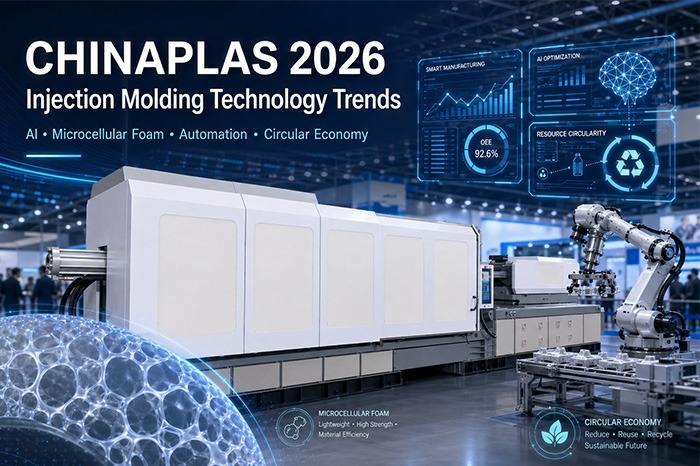
CHINAPLAS 2026 has concluded in Shanghai, but the technology directions observed at the exhibition will continue to influence the plastics and rubber industry in the coming years. For injection molding manufacturers, the discussion was not only about larger machines, faster cycle times, or more advanced control panels. A clear message from the show was that customers are now evaluating the complete production system.
From Huarong’s observation, many discussions at the exhibition reflected practical factory challenges. Manufacturers are looking for ways to reduce material consumption, stabilize product quality, process recycled materials more reliably, reduce dependence on manual operation, and prepare for smart manufacturing.
As a Taiwan-based injection molding machine manufacturer with over 40 years of experience, Huarong Group reviewed CHINAPLAS 2026 from both a technical and application perspective. We believe the most important CHINAPLAS 2026 injection molding technology trends can be summarized into five connected directions:
- AI-assisted injection molding is becoming a practical production support tool.
- Physical foaming and microcellular foam injection molding are receiving stronger attention.
- Multi component injection molding is supporting more integrated product design.
- Automation is becoming part of overall production planning.
- Circular economy requirements are changing how manufacturers evaluate machines and processes.
H2:AI-Assisted Injection Molding Evolves into a Practical Production Tool
Artificial Intelligence was undeniably one of the most prominent topics at CHINAPLAS 2026. Numerous exhibitors demonstrated advanced systems dedicated to process monitoring, production data analysis, parameter optimization, defect prediction, and seamless smart factory connectivity.
However, from a pragmatic standpoint in injection molding, AI should not be seen as a shortcut that supersedes fundamental molding expertise. The injection molding process remains deeply influenced by resin conditions, drying quality, mold design, screw geometry, temperature control, cooling efficiency, machine responsiveness, and operators' nuanced experience.
What AI excels at is empowering factories to monitor production data with unprecedented consistency. For instance, when critical parameters such as injection pressure, melt temperature, cycle time, or screw recovery exhibit subtle deviations, an AI-assisted system can alert operators to abnormal trends far earlier than manual observation. This proactive approach supports more stable production runs and significantly reduces repetitive trial-and-error adjustments.
For manyinjection molding businesses, the initial step toward implementing injection molding AI is not necessarily investing in the most complex, proprietary system available. A far more realistic and foundational starting point is establishing robust architecture for reliable production data collection.
This essential foundation includes:
- Ensuring stable and repeatable machine control mechanisms.
- Maintaining clear, accessible, and standardized molding parameter records.
- Implementing consistent and continuous production data acquisition.
- Establishing seamless communication protocols between individual machines and central factory management systems.
- Training operators to accurately interpret and respond to process variations.
Huarong firmly believes that AI integration must be constructed upon a bedrock of practical machine performance and open connectivity standards. A truly intelligent molding system should assist customers in enhancing production control without confining them within a restrictive, closed ecosystem. This philosophy drives Huarong’s continuous commitment to supporting customers for the future evolution of smart factories.
H2:The Ascendance of Physical Foaming and Microcellular Foam Injection Molding
Sustainability emerged as another dominant theme following CHINAPLAS 2026. Within the injection molding sector, sustainability has evolved beyond the mere utilization of recycled resins. Customers are increasingly focused on holistic material conservation, substantial weight reduction, enhanced energy efficiency, minimized scrap rates, and the pursuit of uncompromising production stability.
Physical foaming injection molding stood out as a pivotal technology addressing these multifaceted demands.
#貼上圖片:https://i.meee.com.tw/UEGk4Pa.webp
Fundamentally, physical foaming introduces an inert gas, typically supercritical nitrogen or carbon dioxide, during the plasticizing phase. As the polymer melt is injected into the mold cavity, the sudden pressure drop induces the formation of a fine, uniform cellular structure within the core of the molded part. When applied to suitable product geometries, compatible materials, and optimized mold designs, this process offers a compelling array of advantages. It can significantly reduce overall part weight, lower raw material consumption, alleviate internal residual stresses, and drastically improve the dimensional stability of the final product.
For Huarong, microcellular foam injection molding should not be understood only as a lightweighting technology. In many real applications, weight reduction is only one of the additional benefits. The more important value is improving dimensional stability.
Based on Huarong’s customer application experience, many manufacturers evaluate microcellular foam injection molding to address shrinkage, sink marks, and warpage. This is especially common in thick-wall products and automotive components that require stable dimensions.
#貼上圖片:http://huarong.com.tw/uploads/product_machine/7_1.webp

In general injection molding, these products may require longer holding pressure time, longer cooling time, or additional fixtures to control shrinkage and deformation. As a result, production output and yield may be limited, even when the machine and mold are already properly adjusted.
By applying microcellular foam injection molding, fine internal cell structures are formed inside the molded part. This can help reduce internal stress and improve dimensional stability. At the same time, customers may also gain additional benefits such as lower part weight and lower material consumption.
For many Huarong customers, the main reason for adopting microcellular foam injection molding is not simply to make the product lighter. The practical goal is to produce more stable parts, reduce the risk of deformation, and improve production efficiency. Lightweighting and material saving then become valuable additional results.
Possible benefits include:
- Improved dimensional stability for suitable products.
- Reduced risk of shrinkage, sink marks, and warpage.
- Lower holding pressure demand.
- Potential reduction in cooling or fixture-related control time.
- Lower part weight as an additional benefit.
- Lower material consumption under suitable product and mold conditions.
This is especially relevant for manufacturers producing thick-wall parts, automotive components, or products with strict dimensional requirements. Reducing plastic usage through process design is valuable, but in many applications, the first priority is achieving stable, repeatable part quality.
Huarong has been actively developing microcellular foam injection molding solutions and continues to support customers in evaluating whether this technology is suitable for their products. In our experience, success depends on a comprehensive review of resin type, product wall thickness, strength requirements, mold design, surface requirements, dimensional tolerances, and production targets.Only when these conditions are reviewed together can microcellular foam injection molding become a reliable production solution.
#貼上圖片:https://www.huarong.com.tw/uploads/product_machine/5_HRF200_cover.png
Suggested machine: Microcellular Foam Injection Molding Machine – HRC Series
H2:Multi-Component Injection Molding Drives Integrated Product Design
A critical observation from CHINAPLAS 2026 is the accelerating cross-industry shift toward highly integrated product designs. Plastic components are increasingly transitioning away from simple, single-material structures. Across diverse sectors, including automotive manufacturing, consumer electronics, household appliances, medical devices, and premium consumer goods, a single part frequently demands a combination of distinct colors, varying material properties (such as rigid and soft-touch areas), transparent optical sections, integrated sealing gaskets, or complex decorative finishes.
This design evolution underscores the growing indispensability of multi-component injection molding.
#貼上圖片:https://www.huarong.com.tw/uploads/company_news/2024-12-11-104626-1.jpg
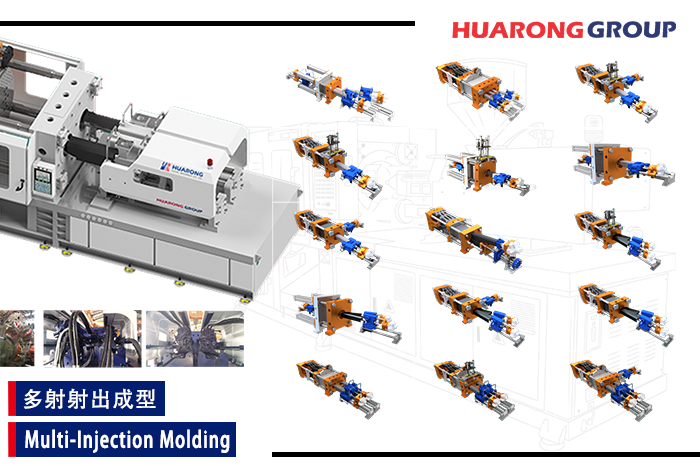
Multi-component injection molding seamlessly integrates disparate materials or colors within a single, continuous molding cycle. When the machine architecture, mold design, material compatibility, and process parameters are meticulously orchestrated, this technology delivers transformative benefits. It effectively eliminates the need for secondary assembly operations, ensures superior and consistent bonding between different materials, drastically shortens the overall production workflow, and elevates the aesthetic and functional quality of the final product.
For manufacturers, the true value proposition extends beyond the capability to produce a more complex part. The profound advantage lies in strategically reducing the total number of manufacturing steps.
Consider a product that historically necessitated separate molding processes for individual components, followed by manual assembly, adhesive bonding, or extensive post-processing. By redesigning this workflow into a consolidated multi-component molding process, manufacturers can achieve unparalleled consistency while simultaneously reducing their reliance on manual labor.
Huarong’s advanced multi-component injection molding solutions are meticulously engineered around specific application requirements. We collaborate closely with customers to evaluate optimal injection unit configurations, select appropriate rotary table or complex mold movement designs, verify material adhesion compatibility, optimize the molding sequence, and assess the feasibility of full automation integration.
For demanding applications such as sophisticated automotive lighting lenses, intricate dual-color consumer products, precision insert molding, and highly functional plastic assemblies, Huarong provides comprehensive support. We assist customers in reviewing not just the machine specifications, but the entire, optimized production methodology.
#貼上圖片:https://www.huarong.com.tw/uploads/product_machine/HDC-co-injection-molding-machine.webp

Suggested machine: Double Injection Molding Machine – HDC Series
H2:Automation Transitions from Add-on to Core Production Strategy
At CHINAPLAS 2026, the concept of automation systems matured significantly. It was no longer merely depicted as a standalone robotic arm positioned beside an injection molding machine. The definitive trend is a decisive move toward comprehensive, holistic production planning.
For many manufacturing facilities, the primary bottleneck does not necessarily reside within the molding machine's cycle time. Inefficiencies frequently stem from manual insert molding procedures, cumbersome part removal, inadequate cooling protocols, inconsistent quality inspection, complex assembly tasks, inefficient packaging, or the inherent variability of manual operator handling. If these sequential steps are not analyzed and optimized as a cohesive system, even the most high-performance injection molding machine will fail to deliver its anticipated production efficiency.
At Huarong, automation planning usually starts from the customer’s actual production site and product condition. Our team does not begin by simply recommending a robot or a standard automation package. Instead, we review the production process step by step and help customers clarify what kind of automation solution is truly needed.
#貼上圖片
- 英文版:https://i.meee.com.tw/PM2Xhup.webp
- 繁體版:https://i.meee.com.tw/uYhGJG8.webp
- 簡體版:https://i.meee.com.tw/hYVKF0m.webp
In practical projects, Huarong’s automation planning can usually be divided into four key steps:
- Current State Audit
We first review the customer’s current production process, including the molded product, machine type, mold layout, manual operation steps, part removal method, cycle time, space limitation, and existing production bottlenecks. - Collect Data
We then collect production-related information, such as product size and weight, mold drawings, process videos, insert loading requirements, inspection needs, assembly steps, packaging method, and factory layout. These details help our team understand the actual production flow rather than designing automation based solely on assumptions. - Confirm Targets
After reviewing the current process and data, we confirm the customer’s automation goals. Some customers want to reduce labor. Some want to improve cycle consistency. Others need better-quality inspection, safer operation, higher output, or future integration with production management systems. - Solution Design
Based on the confirmed targets, Huarong develops a suitable automation concept. This may include robotic take-out, insert loading, conveyor design, cooling, inspection, assembly, packaging, and integration with the injection molding machine. The goal is to create a practical production system that fits the customer’s product, factory space, and long term production plan.
Huarong’s advantage is customized automation integration. Instead of offering only standard equipment packages, we evaluate the customer’s actual production process and product requirements before proposing a solution.
For example, Huarong’s automated double shot hair clip molding system shows how injection molding, part handling, assembly related workflow, and automation planning can be connected into one production solution. This kind of project is not only about adding automation equipment. It requires coordination between the machine, mold, robot, fixtures, inspection, assembly flow, and final packaging.
For large plastic injection-molding parts, Huarong’s two-platen injection-molding machines can also serve as the core of automated production cells. With a compact structure, large mold capacity, and a longer mold-opening stroke, two-platen machines are suitable for customers who need both high molding performance and space for automation.
With this step-by-step approach, automation becomes more than an add-on. It becomes part of the customer’s production strategy.
#貼上圖片:https://www.huarong.com.tw/uploads/product_machine/NRH-2-Platen-injection-molding-machine_1.png

Suggested machine: Two platen injection molding machine – NRH series
H2:Circular Economy Mandates Redefine Machine Evaluation Criteria
The circular economy was a pervasive and critical topic throughout CHINAPLAS 2026. An increasing number of manufacturers are actively evaluating the integration of recycled materials, striving to minimize waste generation, implementing rigorous material traceability, and committing to substantial reductions in their carbon footprints.
For injection molding facilities, this paradigm shift introduces complex new challenges. Recycled materials inherently exhibit greater variability compared to prime virgin resins. Fluctuations in melt viscosity, moisture content, contaminant presence, color inconsistencies, and varying mechanical properties can profoundly affect molding stability and final part quality.
This reality dictates that machine selection criteria must expand beyond basic specifications to place greater weight onmaterial adaptability.
When processing recycled materials or complex material blends, manufacturers must prioritize machines that offer:
- Unwavering plasticizing stability under varying material conditions.
- Exceptional injection control accuracy to compensate for viscosity shifts.
- Precise and responsive temperature management across the barrel.
- Optimized screw and barrel designs tailored for challenging materials.
- Integration with advanced drying and feeding systems to ensure material consistency.
- Comprehensive process monitoring capabilities to detect anomalies instantly.
- Robust production data recording for traceability and continuous improvement.
- The proven ability to maintain stringent quality consistency despite inherent material variations.
Huarong supports customers who are evaluating recycled materials, plastic reduction, and sustainable molding strategies. Depending on the product and production target, customers may consider servo-hydraulic injection molding machines, microcellular foam injection molding, multi-component molding, customized automation integration, or Huarong’s Energy-Efficient Direct-Drive Material Storage Motor.
When dealing with viscosity variation in recycled materials, stable plasticizing performance and accurate injection control become especially important. Huarong’s servo hydraulic systems are designed to provide stable and practical process control for a wide range of molding applications.
#貼上圖片:https://www.huarong.com.tw/uploads/product_machine/Servo%20Option.webp
Suggested machine: Servo Injection Molding Machines – HRS & HRFC Series
In addition, Huarong’s Energy Efficient Direct Drive Material Storage Motor can further support energy saving and production efficiency. This patented direct drive material storage servo motor is designed to handle high axial and torque loads. By directly driving the material storage screw with a servo motor, the system eliminates the need for traditional hydraulic motors and gearboxes, creating a simpler transmission structure with more stable performance and lower maintenance requirements.
This technology can be applied across Huarong’s horizontal injection molding machine lineup, making it suitable for manufacturers that want to improve energy efficiency not only in a specific model, but across different horizontal machine applications.
According to Huarong’s product information, this system can reduce energy consumption by up to 26% during material storage. It can also operate independently, allowing material storage to run at the same time as product cooling and mold opening, which may help shorten the molding cycle and improve production efficiency.
#貼上圖片:https://www.huarong.com.tw/uploads/features/png-4.webp
In Huarong’s view, circular economy is not only about changing materials. It is about building a production system that can maintain quality, stability, energy efficiency, and production flexibility even when material conditions become more complex.
H2:Huarong’s Strategic Perspective Post-CHINAPLAS 2026
The conclusion of CHINAPLAS 2026 illuminated a fundamental truth: modern manufacturers are no longer merely seeking equipment vendors. They are actively searching for strategic technical partners capable of comprehensively evaluating complete production feasibility.
While fundamental machine specifications—such as clamping force, maximum shot weight, platen dimensions, tie-bar spacing, injection pressure, and mold opening stroke—remain critical foundational metrics, they now represent only a fraction of the overall investment decision.
Forward-thinking customers are posing highly practical, system-level questions:
- Is this specific machine architecture optimally suited for my unique product geometry and material selection?
- Can the proposed process technology tangibly reduce my overall material consumption?
- Is the system architecture designed to seamlessly integrate automation, either immediately or as a future upgrade?
- Does the equipment possess the robust control and plasticizing capabilities required to process recycled materials consistently?
- Is the machine equipped to capture, structure, and transmit production data for future smart manufacturing initiatives?
- Can the supplier provide expert consultation to review and optimize the mold design, process parameters, and overall production flow prior to capital investment?
This comprehensive, consultative approach is precisely where Huarong delivers exceptional value.
Huarong Group offers an extensive portfolio encompassing horizontal injection molding machines, highly specialized vertical injection molding machines, advanced multi-component injection molding systems, space-efficient two-platen injection molding machines, cutting-edge microcellular foam injection molding systems, and bespoke automation integration services.
Our primary objective transcends the mere delivery of machinery. We are committed to partnering with our customers to meticulously evaluate the entire molding process, optimize machine configurations, design efficient automation layouts, and formulate sustainable, long-term production strategies.
H2:Strategic Review for Manufacturers Post-CHINAPLAS 2026
For manufacturers embarking on new injection molding projects, the advanced technologies exhibited at CHINAPLAS 2026 must not be viewed as isolated, independent trends. AI integration, microcellular foam injection molding, comprehensive automation, multi-component processing, and circular economy initiatives must be evaluated synergistically against actual, pressing production needs.
Prior to finalizing new equipment selections, manufacturers are encouraged to conduct a rigorous internal review based on the following critical questions:
| Evaluation Criteria | Key Considerations |
|---|---|
| Primary Production Pain Points | Identify the core challenges: Is the primary constraint escalating labor costs, excessive cycle times, unacceptable defect rates, volatile material costs, high energy consumption, inconsistent product quality, or severely limited factory floor space? |
| Specific Product Requirements | Analyze how part dimensions, varying wall thicknesses, specific material properties, critical surface finish requirements, mechanical strength demands, and final assembly methodologies will dictate machine architecture and process selection. |
| Machine Configuration Suitability | Determine if the application necessitates a standard horizontal machine, a vertical machine for complex insert molding, a multi-component system for integrated designs, or a robust two-platen machine to accommodate large molds within a compact footprint. |
| Automation Feasibility and Timing | Assess whether automation is required immediately to meet production targets or if the system should be designed with the flexibility to integrate automation in a phased approach as production scales. |
| Material Strategy and Sustainability | Evaluate if the production process will incorporate recycled resins, utilize physical foaming technologies for lightweighting, or demand specialized screw designs to handle complex material blends effectively. |
| Smart Manufacturing Readiness | Determine if the facility plans to implement smart manufacturing protocols in the foreseeable future. If so, ensure that machine data accessibility, open communication protocols, and structured production record capabilities are fundamental requirements before the system architecture is finalized. |
By adopting this holistic evaluation framework, manufacturers can effectively mitigate the risk of investing in advanced technologies that fail to resolve their fundamental production challenges.
H2:Conclusion: Engineering a More Integrated Future for Injection Molding
CHINAPLAS 2026 definitively demonstrated that the injection molding industry is accelerating toward a highly integrated, systems-oriented future. AI-assisted process control, microcellular foam injection molding, sophisticated multi-component molding, seamless automation integration, and the imperatives of the circular economy are no longer disparate concepts. They are interconnected, synergistic responses to a unified market demand: the imperative to manufacture superior components with unprecedented stability, minimized waste, and highly flexible, adaptable production planning.
If you are currently evaluating a new injection molding initiative following CHINAPLAS 2026, Huarong stands ready to assist. We invite you to collaborate with our experts to comprehensively review your product designs, material selections, mold concepts, production targets, and automation requirements, ensuring the development of a practical, highly efficient, and infinitely scalable manufacturing solution.