


Busbar Insert Molding in India: Customer Application and Machine Selection
2026-11-12 10:13:25
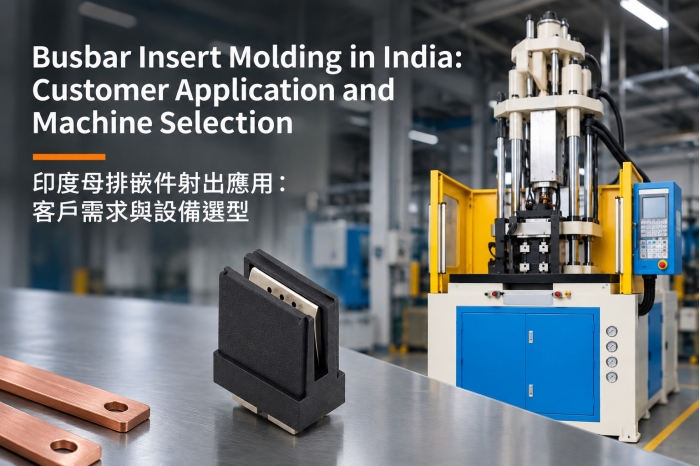
Busbar insert molding combines metal electrical conductors with injection molded plastic to provide insulation and structural support. For manufacturers producing these components, maintaining accurate insert positioning, consistent insulation quality, and stable production is essential.
Huarong works with customers in India manufacturing busbar related components and is preparing injection molding equipment for this application. This customer application explores the manufacturing challenges, machine selection considerations, and importance of local technical support.
H2:Customer Background: Busbar Manufacturing in India
Our customer in India manufactures busbar related electrical components that require the integration of metal conductors and molded plastic parts.
#插入圖片:https://i.meee.com.tw/Npk2wls.png
Busbars are commonly made from copper or aluminum and are used to distribute electrical power. Depending on the application, plastic overmolding can provide insulation, mechanical support, and positioning features.
Typical applications include:
- Electric vehicle battery and power distribution systems
- Motor and inverter electrical connections
- Industrial electrical distribution assemblies
- Power electronics and electrical interconnection modules
Unlike conventional injection molding, busbar insert molding requires metal conductors to be positioned inside the mold before plastic injection.
Similar manufacturing considerations also apply to electrical connector production, where metal terminals and cable components must be positioned accurately. Huarong previously discussed these requirements in our Electrical Connector Insert Molding Customer Case.
For busbar manufacturers, however, conductor geometry, insulation coverage, and thermal requirements introduce additional engineering considerations.
H2:Understanding the Customer's Production Challenges
From the manufacturer's perspective, purchasing an injection molding machine involves more than comparing clamping force or injection capacity.
The machine must be practical for daily production, especially when operators need to position metal conductors accurately before every molding cycle.
H3:Challenge 1: Accurate Busbar Positioning
Busbar inserts must remain correctly positioned during mold closing and plastic injection.
If a conductor moves, it may affect insulation thickness, exposed terminal alignment, or final part dimensions.
The main engineering considerations include:
- Metal insert locating and supporting fixtures
- Mold closing sequence and protection
- Gate design and plastic flow direction
- Insert positioning repeatability
For critical components, insert presence detection or machine vision may also be evaluated to help prevent incorrect loading or unintended mold closing.
Huarong's article on Injection Molding Vision Inspection and Mold Protection explains how inspection timing, sensor feedback, and machine control can be integrated into the molding process.
H3:Challenge 2: Consistent Insulation and Part Quality
The plastic surrounding a busbar may serve an important electrical insulation function.
Incomplete filling, cracks, excessive warpage, or incorrect insert positioning can affect finished part quality.
Material selection is therefore important. Engineering plastics such as PPS, PPA, and PBT may be evaluated depending on operating temperature, electrical properties, and mechanical requirements.
The customer must also consider the interaction between metal and plastic during heating and cooling, particularly where thermal expansion differences may generate stress around the insert.
The selected material and molded component should be validated against the required electrical, dimensional, and thermal specifications.
H3:Challenge 3: Practical Loading and Production Efficiency
Busbar components vary in length, shape, and complexity.
Some designs require operators to position multiple metal conductors inside the mold. Others may be suitable for automated insert loading.
The customer therefore needs to evaluate not only the injection process but also how operators or robots will handle the inserts.
Important considerations include:
- Available mold loading space
- Operator accessibility and safety
- Insert positioning fixtures
- Loading and unloading time
- Future automation requirements
The objective is to establish a repeatable production workflow rather than simply achieve the shortest possible machine cycle.
H2:Huarong's Approach to Busbar Insert Molding Machine Selection
For the Indian customer application, Huarong's equipment preparation involves evaluating the product and production requirements before confirming the machine configuration.
Machine selection should consider the busbar dimensions, metal insert positioning method, mold layout, resin, injection requirements, and intended production volume.
H3:Evaluating Vertical Injection Molding Machines
Vertical injection molding machines are frequently considered for insert molding because they can provide accessible mold areas for placing metal components.
#插入圖片: https://www.huarong.com.tw/uploads/product_center/product_center_banner_02.webp
Huarong Group offers different configurations that may be evaluated for busbar applications.
| Machine Configuration | Application Consideration |
| YR Series, Rotary Table | Repeated insert loading and multi-station production workflows |
| YL Series, Tie Bar Less | Long or irregularly shaped inserts requiring open mold access |
| YC Series, Vertical Clamping and Horizontal Injection | Applications requiring accessible mold space and horizontal injection |
For example, a long busbar may require additional clearance around the mold, while an assembly containing several smaller conductors may benefit from a rotary table arrangement.
However, a vertical machine is not automatically the best choice for every busbar component. Horizontal injection molding may also be suitable when the mold, insert retention system, and automation are designed accordingly.
Machine compatibility must be confirmed using the actual mold, part, and process specifications.
Before selecting a machine, manufacturers may also refer to Huarong's guide on Five Common Vertical Injection Molding Machine Selection Mistakes, which explains why clamping force alone cannot determine whether a machine will meet production requirements.
Explore Huarong's Vertical Injection Molding Machine configurations for additional equipment information.
H2:Why Local After Sales Support Matters to Indian Manufacturers
For manufacturers purchasing injection molding equipment from an overseas supplier, one important consideration is the availability of local technical support.
Even when a machine meets the required specifications, daily production may involve process adjustments, maintenance, operator training, and troubleshooting.
Huarong maintains an India-based support network, with a registered office in Ahmedabad and published branch office and service center coverage in Delhi, Mumbai, Chennai, Bangalore, Ahmedabad, and Pune.
Depending on the project and agreed service arrangements, local support may assist with:
- Machine installation and commissioning
- Operator training and maintenance guidance
- Technical troubleshooting
- Communication with Huarong's Taiwan engineering team
For the customer, local service availability is an important part of evaluating long-term equipment operation.
It provides an established support channel when technical assistance or maintenance coordination is required.
Learn more about Huarong's Service Network in India.
H2:Preparing for Production: What Needs to Be Verified?
As the equipment is prepared for the busbar molding application, the machine, mold, material, and loading process must be evaluated together.
The following items should be confirmed before production approval.
| Evaluation Item | What Should Be Confirmed |
| Insert positioning | Conductors remain correctly located during molding |
| Mold compatibility | Mold dimensions, opening stroke, and loading clearance |
| Injection performance | Shot requirements, injection pressure, and speed capability |
| Insulation quality | Plastic coverage, dimensions, and specified electrical tests |
| Production workflow | Insert loading, part removal, cycle time, and automation |
| Service arrangements | Commissioning, training, and maintenance support |
For process stability, engineers should also establish suitable operating ranges for material preparation, melt and mold temperatures, injection speed, pressure transfer, holding conditions, and cooling.
Huarong's technical article, Injection Molding Process Parameters: How to Build a Stable Process Window, provides additional guidance on developing repeatable molding conditions and evaluating production variation.
Complete these evaluations using the actual product, mold, and material requirements rather than relying only on machine specifications.
H2:Frequently Asked Questions
H3:1. Why is vertical injection molding considered for busbar components?
Vertical injection molding can provide convenient access for positioning metal inserts in the mold. Depending on the production requirements, rotary or sliding tables may also support loading and unloading workflows.
H3:2. Can busbar insert molding be automated?
Yes. Depending on the insert geometry and production volume, manufacturers may evaluate robotic loading, positioning fixtures, insert detection, and automated part removal.
H3:3. Does Huarong provide local service support in India?
Yes. Huarong has an established India-based service network. The specific support scope and arrangements should be confirmed according to the project and installation location.
H2:Conclusion: Supporting Busbar Manufacturers in India
Busbar insert molding requires more than an injection molding machine with sufficient clamping force. The metal conductor, mold, plastic material, insert positioning system, and production process must work together to achieve consistent results.
For Huarong's Indian customer application, equipment preparation involves understanding the component requirements, evaluating suitable machine configurations, and considering the practical needs of factory operation.
With its vertical injection molding machine range and established service network in India, Huarong can help manufacturers evaluate equipment solutions for busbar and other electrical component applications.
H3:Looking for an injection molding machine for busbar manufacturing?
Share your product drawings, metal insert dimensions, resin grade, mold information, and production requirements with Huarong. Our team can discuss suitable machine configurations and technical support arrangements for your project.