Insert Molding Automation Guide: Machines, Robots, Tooling and ROI
2026-06-10 14:22:50
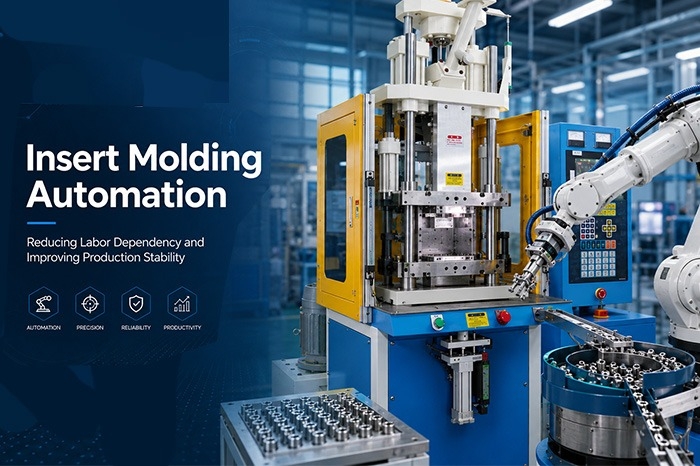
Insert molding automation helps manufacturers reduce manual insert loading by integrating injection molding machines, robots, fixtures, insert-feeding systems, sensors, and safety controls into a single coordinated production cell. It is commonly used for parts with metal terminals, threaded inserts, bushings, pins, connectors, brackets, or electronic components.
In manual insert molding, operators place inserts into the mold before each shot. This may be acceptable for low-volume production, but it can become a bottleneck when production volume increases. Manual loading may lead to unstable cycle time, operator fatigue, insert misplacement, scrap, and mold damage. This guide explains how insert molding automation works, when vertical injection molding machines are suitable, and how manufacturers can evaluate the appropriate level of automation for their production needs.
H2:What Is Insert Molding Automation?
Insert molding automation means integrating automated equipment into the insert molding process to reduce manual loading and improve production control.
A complete automated insert molding system may include:
- A vertical injection molding machine
- A slide table, rotary table, or tie-bar-less machine structure
- An insert feeding system
- A robot or manipulator arm
- End-of-arm tooling for insert gripping and part removal
- Mold positioning features and insert fixtures
- Sensors or vision inspection for insert confirmation
- Safety interlocks and I/O signal communication
- Production monitoring or smart factory management
The main purpose is not only to replace operators. A well-designed insert molding automation cell should also reduce unstable loading, prevent insert missing or misalignment, protect the mold, and make production easier to manage.
H2:Why Vertical Injection Molding Machines Are Commonly Used for Insert Molding
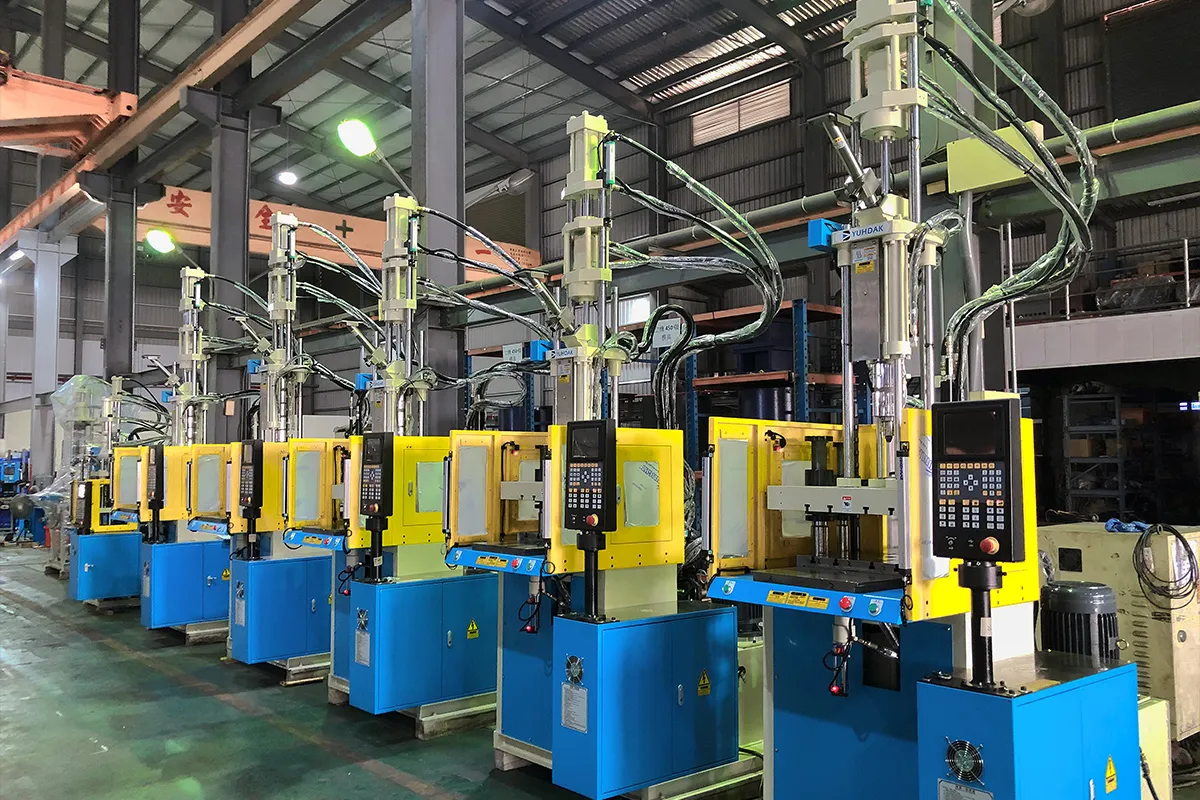
Vertical injection molding machines are widely used for insert molding because the mold opens in a way that helps insert placement. When the mold is open, the lower mold surface faces upward. This allows inserts to sit in the mold by gravity before the mold closes.
圖片:https://i.postimg.cc/cHgJMpKG/What-is-vertical-injection-molding.webp
This structure is useful for metal nuts, terminals, bushings, connector pins, and small brackets. Compared with a horizontal machine, a vertical machine usually provides easier access for manual loading, robotic placement, and fixture design.
For automation planning, three vertical machine structures are especially important.
H3:Slide Table Vertical Injection Molding Machine
A slide table machine allows one station to stay inside the molding area while the other station stays outside for insert loading or part removal. This design overlaps the insert loading time with the injection molding time.
圖片:https://www.huarong.com.tw/uploads/features/03-01-01.webp
It is suitable for medium-volume production, operator-assisted insert loading, and applications where the factory wants higher efficiency without immediately moving to full automation.
Recommended machine: Sliding Table Vertical Injection Machine – YH Series
H3:Rotary Table Vertical Injection Molding Machine
A rotary table machine is suitable for continuous, repetitive production. The table indexes from one station to another, allowing insert loading, injection molding, cooling, or part removal to be arranged in a more stable sequence.
影片:https://www.youtube.com/embed/_dns6gVnCjY?si=bPP8CDKBGdQ4wGDf
It is useful when the process requires consistent station timing, multi-cavity loading, or higher output.
Recommended machine: Rotary Table Vertical Injection Machine - YR Series
H3:Tie-Bar-Less Vertical Injection Molding Machine
Some inserts are large, wide or irregular. A tie-bar-less vertical machine provides more open access around the mold area, which can help when loading large frames, electronic modules, long brackets or complex insert assemblies.
圖片: https://www.huarong.com.tw/uploads/product_machine/YL-Series-injection-molding-machine.webp
This type of machine is usually considered when mold access and insert handling are more difficult than standard insert molding.
Recommended machine: Tie-bar-less Vertical Injection Machine – YL Series
H2:Key Components of an Automated Insert Molding System
A reliable insert molding automation cell depends on several subsystems. If one subsystem is unstable, the whole production cell may stop frequently.
H3:1. Insert Feeding System
The insert feeding system stores, orients, and delivers inserts to the robot pickup position. The correct feeding method depends on insert size, shape, surface condition, and required cycle time.
Common feeding methods include:
- Vibratory bowl feeder for small pins, bushings and terminals
- Tray feeder for larger or pre-oriented inserts
- Magazine feeder for stacked or aligned inserts
- Reel feeder for stamped metal terminals
- Manual loading station for low-volume or high-mix production
Before selecting a feeder, manufacturers should check insert tolerance, burrs, oil residue, deformation, and packaging method. Many automation problems are caused by unstable insert supply rather than by the injection molding machine itself.
H3:2. Robot or Manipulator
The robot must match the required speed, motion path, payload and placement accuracy. In some cases, a simple pick-and-place manipulator is enough. In more complex applications, a multi-axis robot may be needed.
urther reading: Comprehensive Guide to Injection Molding Robots: Automate Your Production Process
H3:3. End-of-Arm Tooling
End-of-arm tooling directly affects whether the robot can pick, hold, place and release the insert consistently.
Common methods include vacuum suction, mechanical grippers, magnetic pickup, custom nests, and multi-pick grippers. The tooling should be designed for long-term repeatability, not only for successful trial operation.
H3:4. Mold and Fixture Design
The mold is one of the most important parts of insert molding automation. A mold designed only for manual loading may not be suitable for robotic loading.
Automation-friendly mold design may include:
- Clear locating pins or insert nests
- Chamfers to guide insert placement
- Poka-yoke design to prevent wrong orientation
- Enough gripper clearance
- Sensor space for insert confirmation
- Stable support during mold closing
- Venting near insert areas
- Flow design that reduces insert movement during injection
H3:5. Sensors, Vision and Safety Interlocks
Sensors and vision systems can confirm whether the insert is present and correctly positioned before mold closing. This is important because a missing or misplaced insert can damage the mold.
Common inspection methods include proximity sensors, fiber sensors, mechanical confirmation pins, and camera-based inspection.
For automated insert molding, machine-robot communication is also critical. The system must confirm mold open, robot safe position, insert placement complete, part removal complete, and emergency stop status before the next movement begins.
Further reading: Injection Molding Machine I/O Signals: Robot, Auxiliary Equipment, and Safety Interlock Guide
H2:How Insert Molding Automation Improves Production
Insert molding automation can improve production in several ways, but the improvement depends on the actual bottleneck.
H3:Labor Reduction
If one operator is required per machine, automation may allow a single operator to supervise multiple machines or a production cell. This is usually the clearest benefit for high-volume insert molding.
H3:More Stable Cycle Time
Manual loading speed changes from operator to operator. Automation can reduce this variation by using a fixed movement sequence. If insert loading can be overlapped with molding time using a slide table or rotary table, the overall cycle time may also become more efficient.
Further reading: Injection Molding Cycle Time: The Key to Faster and Smarter Manufacturing
H3:Better Insert Placement Consistency
A robot places inserts based on programmed positions and fixtures. When the feeder, gripper and mold nest are stable, placement consistency can be improved compared with manual operation.
H4:Lower Risk of Mold Damage
In insert molding, a single incorrect insert position can damage the mold. Insert confirmation sensors and interlock logic to help prevent the mold from closing when the insert is missing or incorrectly positioned.
H4:Easier Quality Control
Automation can connect molding with inspection, reject sorting, assembly, or packaging. This helps separate defective parts earlier and improves process traceability.
H2:Common Defects in Insert Molding and How Automation Helps
Insert molding defects often come from insert positioning, material flow, mold structure or process control. Automation can reduce some risks, but it cannot fix a poor mold or unstable insert supply.
| Defect | Common Cause | How Automation Helps |
|---|---|---|
| Insert misplacement | Manual loading variation, weak fixture design | Robotic placement and sensor confirmation |
| Insert deformation | Thin insert, poor support, mold closing interference | Better nest design and controlled placement |
| Flash around insert | Poor insert fit, mold wear, excessive pressure | Better insert tolerance control and mold maintenance |
| Short shot near insert | Flow obstruction, poor venting | Mold flow review and venting improvement |
| Weak bonding | Material mismatch, contamination, low temperature | Insert cleaning and stable process settings |
| Mold damage | Missing or misplaced insert | Insert detection before mold closing |
H2:When Should You Consider Insert Molding Automation?
A manufacturer should consider insert molding automation when one or more of these conditions appear:
- Operators spend most of the cycle placing inserts
- Insert loading causes unstable cycle time
- One operator can only manage one machine
- Insert misplacement causes scrap or mold damage
- The same part is produced for a long period
- Production runs two or three shifts per day
- Multiple inserts must be loaded in each shot
- Quality requirements need repeatable positioning
- The molding process must connect with inspection, assembly or packaging
Automation may not be the first choice when production volume is low, the product design is not stable, insert supply is inconsistent or the mold is not ready for automated loading.
H2:ROI Considerations for Insert Molding Automation
The return on investment depends on labor cost, production volume, scrap cost, downtime and automation investment.
Before making a decision, manufacturers should calculate:
- Current operators per shift
- Number of shifts per day
- Monthly labor cost
- Current cycle time
- Machine idle time caused by manual loading
- Defect rate related to insert placement
- Mold damage risk
- Expected operator reduction
- Automation equipment cost
- Maintenance and training cost
For suitable high-volume applications, a 40% labor reduction target may be realistic. Higher savings may be possible when the system includes insert feeding, robotic loading, part removal, inspection and downstream automation. However, the estimate should be based on actual production data, not only on general automation assumptions.
H2:Practical Implementation Roadmap
A practical insert molding automation project can be developed in five steps.
H3:Step 1: Review the Current Manual Process
Record current cycle time, insert loading time, mold open time, defect rate, operator allocation and scrap causes.
H3:Step 2: Check Insert Suitability
Review insert size, shape, tolerance, burrs, oil residue, deformation, surface condition and packaging method.
H3:Step 3: Review Mold and Fixture Design
Confirm whether the mold has stable insert locating features, enough gripper access, sensor space, and protection against insert movement.
H3:Step 4: Select the Machine and Automation Concept
Choose a slide table, a rotary table, a tie-bar-less or a multi-component machine structure based on production flow and insert handling needs.
H3:Step 5: Test and Validate Before Mass Production
Run dry tests, low-speed trials and process validation. Confirm insert placement, mold closing safety, robot repeatability, part quality and alarm recovery procedure.
H2:Why Work with Huarong for Insert Molding Automation?
Insert molding automation requires coordination between machine design, mold matching, robot handling, insert feeding, safety signals and production layout.
Huarong provides vertical injection molding machines, manipulator arms, automation system planning and smart factory management for manufacturers who need more than a standard molding machine.
For customers producing automotive components, electrical parts, consumer products, medical-related components or industrial parts with inserts, Huarong can help evaluate the machine platform, mold access, insert loading method and automation concept based on the actual part and production target.
Related application reference: Dual-Shot Injection Molding & Automated Production Line for Automotive Lamp Lens
#插入HTML碼框框
Tell Us What You Need – We'll Match the Machine
H2:Conclusion
Insert molding automation is most effective when the insert, mold, machine, feeder, robot, sensors, and safety signals are planned as a single, integrated process. For low-volume production, improved fixtures or semi-automatic vertical machines may be enough. For high-volume production, robotic loading, rotary table systems, inspection, and integrated automation cells can provide stronger long-term value.
The right starting point is to review where labor is used, where defects occur, and where cycle time is lost. Based on these findings, manufacturers can select the most practical level of insert-molding automation to ensure stable, efficient production.