


Bottle Cap Production Line: Injection Molding, Cap Mold Design, and Cap Slitting & Folding Integrati
2025-12-05 13:43:11
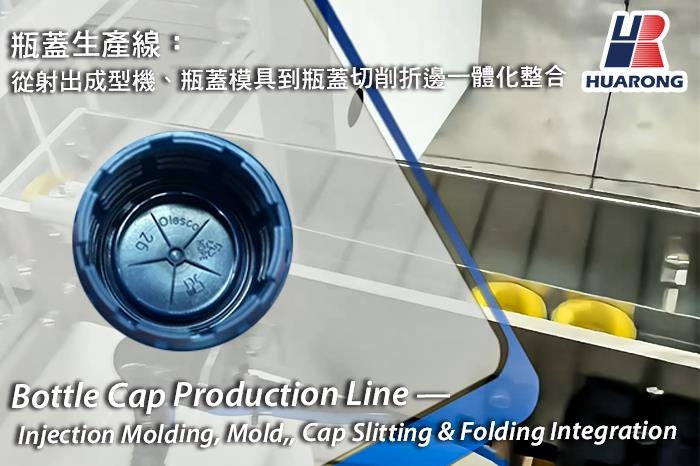
Plastic bottle caps may look simple, but behind every cap is a complete production line. As an injection molding machine manufacturer, we are often asked to supply the machines for caps to integrate the entire bottle cap production line, including plastic cap slitting and folding machines for tamper-evident (TE) bands.
This article explains how to plan and integrate a plastic bottle cap production line that is stable, efficient, and future-ready. We will:
- Revisit the role of the bottle cap injection molding machine
- Discuss cap mold design, including in-mold TE band concepts
- Go deep into the plastic cap slitting and folding machine and how it works in the line
H2:What Is a Plastic Bottle Cap Production Line?
A plastic bottle cap production line is more than just an injection molding machine and a mold. In a typical beverage or edible oil factory, the line usually includes:
- Injection molding machine + cap mold
- Cap handling and conveying system
- Plastic cap slitting and folding machine (for TE bands)
- Optional liner insertion / wad sealing equipment
- Vision inspection and leak testing
- Counting, sorting, and packing system
If you are new to plastic caps and want to review the basic structure, materials, and liner function first, you may refer to our article “The Science Behind Plastic Caps: How are Plastic Bottle Caps Made.”
H2:Bottle Cap Injection Molding Machine
At the heart of every plastic bottle cap production line is the bottle cap injection molding machine. This is where we create the cap body and the basic functional details:
- Internal threads
- Sealing features (conical seal, plug seal, liner seat, etc.)
- TE band geometry (depending on design strategy)
#機台圖片: https://www.huarong.com.tw/uploads/product_machine/HRS-superior-servo-injection-molding-machine.webp
H3:Key requirements for a bottle cap injection molding machine
Compared with general injection molding, bottle caps demand:
- High-speed, repeatable cycling
- Cycle times often in the range of a few seconds
- The clamp must open and close quickly yet smoothly
- High precision and stability
- Tight tolerance on cap diameter, thread pitch, and sealing surface
- Stable injection pressure and injection speed to avoid short shots and flash
- Multi-cavity performance
- 16, 32, 48, 64 or more cavities
- The machine must deliver consistent filling for all cavities, including the ones furthest from the gate
For a deeper overview of different plastic bottle cap types, applications, and international standards that influence machine and mold selection, you can also read “Injection Molding for Plastic Bottle Caps: Manufacturing Processes & Applications.”
Suggested machine: Servo Injection Molding Machines – HRS & HRFC Series
H2:Cap Mold Design and Tamper-Evident Band Concepts
Even before we talk about the cap slitting and folding machine, cap mold design already decides a lot about how the TE band will be formed.
H3:Standard cap mold design (without in-mold TE slitting)
In a typical water or oil cap mold:
- The cap’s skirt and TE band area are molded as one continuous cylinder
- The TE band zone may be slightly thinner or specially shaped, but no slits or hinges are formed in the mold
- After molding, the cap moves to a plastic cap slitting and folding machine, which:
- Cuts slits to form bridges
- Folds the band inward to lock under the neck ring
This approach is simple in terms of mold design and shifts the TE band complexity to the dedicated post-processing machine.
H3:In-mold tamper-evident band concept
In some projects, the tamper-evident (TE) function is built directly into the cap mold, so the cap already has its TE band when it is ejected. The mold creates thin bridges or weakening lines in the band area, or even a tethered hinge, so the band will tear or stay attached as required when the consumer first opens the cap.
Because these shapes are more complex, the injection molding machine must also be prepared, not only in tonnage but in functions:
- Core-pull circuits – to drive sliders or inner cores that form undercuts or locking features.
- Unscrewing circuits – hydraulic or motor-driven, when the thread or inner TE geometry cannot be stripped.
- Controlled ejector sequence – sometimes two-step ejection is needed to push the cap off gently without breaking the bridges.
H4:In-mold TE design vs cap slitting folding machine: pros and cons
In-mold TE band design – Pros:
- Fewer machines on the floor
- Potentially shorter process chain
- No slitting knives to maintain
In-mold TE band design – Cons:
- Molds become more complex and expensive
- TE band design changes (bridge thickness, pattern) require mold modifications
- Maintenance or damage to TE features can stop the entire molding operation
Cap slitting folding machine – Pros:
- High flexibility: Easy to adjust knife depth, number of slits, and folding profiles for different caps
- Specialized high speed: Designed to handle thousands of caps per minute
- Isolation of problems: You can troubleshoot TE band issues at the slitting machine without opening the mold
Cap slitting folding machine – Cons:
- Additional equipment footprint and investment
- Requires proper feeding, orientation, and maintenance
H3:In-mold TE vs. slitting & folding machine – what’s the difference?
| Aspect | In-mold TE band design | Plastic cap slitting & folding machine |
|---|---|---|
| Initial investment | Higher mold cost; fewer machines | Lower mold cost; extra machine investment |
| Number of cap types | Best for 1–2 stable cap designs | Better for many cap types / SKUs |
| Changing TE design | Slow and expensive (modify mold steel) | Fast and cheap (change knives / settings) |
| Cycle time & output | May be slightly slower due to complex demolding | Molding cycle optimized; TE done in a separate high-speed unit |
| Mold complexity | More slides, cores, unscrewing, tight tolerances | Simpler mold; TE complexity moved to post-processing |
| Machine requirements | Needs core-pulls, unscrewing, multi-step ejection | Standard cap machine + simple take-out/conveyor |
| Best suited for customers | Large volume, long-term fixed design | Customers expecting design changes, new markets, or more SKUs |
#CTA-找機台
H2:What Is a Plastic Cap Slitting and Folding Machine?
A plastic cap slitting and folding machine is a dedicated post-molding system that converts plain caps into finished, tamper-evident closures.
- “Slitting”: cutting the skirt of the cap to create a separate TE band connected by small bridges.
- “Folding”: bending this band downward and inward so it can lock under the bottle neck ring during capping and break on first opening.
The machine is normally connected to the injection molding area by conveyors, elevators, and orienting feeders and is designed to run continuously at high speed.
H2:How the Slitting and Folding Process Works in a Cap Production Line?
A typical system runs as a continuous, carousel-based process, with caps passing through several stations:
- Feeding & orientation
- Slitting
- Folding
H3:Cap feeding and orientation
In a running line, caps usually arrive from the injection molding area via a conveyor or a buffer silo. They are then fed into the plastic cap slitting and folding machine, where:
- A hopper or elevator lifts loose caps up to the infeed level.
- An orientation device (such as a bowl feeder or rotary sorter) makes sure caps are all facing the same way.
- A single-lane track, with upper and side guides, gently clamps and aligns the caps before they enter the first carousel.
H3:Slitting station: knives, mandrels, and TE band formation
On the first carousel, the machine performs the slitting step that defines the TE band. For each cap:
- A mandrel or chuck holds the cap from the inside and keeps it round.
- Slitting knives cut the lower skirt at a controlled depth to separate the band from the upper cap wall while leaving small bridges intact.
- As the carousel rotates, every cap passes the same knife positions under the same speed and pressure.
H3:Folding station: wheels, rollers, and profiles
After slitting, the caps are transferred to the folding section, often on a second carousel. Here, the TE band is bent down step by step:
- Folding wheels or profiled rollers touch only the band area, not the sealing surface.
- The band is gradually guided from almost straight to its final downward position.
- The final angle is set so the band can snap under the bottle neck ring during capping and then break cleanly at the bridges when opened.
H2:Integrating Injection Molding with Cap Slitting & Folding in One Line
From an integration perspective, we need to make sure that:
- The output from the injection molding machine matches the capacity of the slitting and folding machine
- Caps flow from one station to the next without jamming or overfilling
- The complete line can be operated and monitored as one coherent system
#崁入影片
H2:Engineering Checklist for Planning a Bottle Cap Production Line
When we design a plastic bottle cap production line, we start fromproduct requirements, not just machine tonnage. Use this checklist as a starting point:
H3:Product definition
- Cap type: water cap, CSD cap, oil cap, sports cap, flip-top, tethered cap, etc.
- Neck finish standard: PCO 1810/1881, 30/25, 38mm, 5-gallon, DIN 45, etc.
- TE band requirement: yes/no, standard or tethered, specific market standards?
- Liner requirement: linerless or with foam / wad / induction seal
H3:Output & capacity
- Target caps per minute / hour / day
- Number of shifts and operating days per month
- Required mold cavities and cycle time to meet demand
- Required capacity of the plastic cap slitting and folding machine (caps/min)
H3:Material & process
- Resin: PP or HDPE, MFI, color masterbatch
- Additives: slip agents, UV stabilizers, antistatic, etc.
- Lightweighting targets (g/cap) and mechanical performance (torque, top load)
H3:Post-processing and automation
- Slitting only, or slitting + folding?
- Vision inspection and leak testing needed?
- Liner insertion or other special operations?
- Required packing format: bags, cartons, or direct feeding to cap elevators in the filling hall
With these answers, we can design a realistic solution covering injection molding machine, cap mold, plastic cap slitting and folding machine, and automation as one package.
If you are specifically considering a bottled water project and want to see how caps and PET preforms can be integrated into one self-reliant cell, you may refer to our case study “Build a Self-Reliant Bottled Water Line with Cap & PET Preform Injection Molding.”
H2:FAQ: Plastic Bottle Cap Production Line & Slitting/Folding
H3:Q1. Should I choose in-mold TE band or a separate plastic cap slitting and folding machine?
It depends on your strategy:
- If your product range is very fixed, volumes are stable, and you want a shorter process chain, in-mold TE band design can be considered.
- If you expect design changes, multiple cap families, or different country standards, a separate plastic cap slitting and folding machine gives much more flexibility and is easier to adjust without rebuilding molds.
H3:Q2. How many cap sizes can one plastic cap slitting and folding machine handle?
Most machines can handle several cap sizes by changing:
- Mandrels
- Knives and folding wheels
- Guides and star wheels
The key is to plan format sets in advance and estimate changeover time. For caps that differ drastically in size (for example, 28mm water caps vs. 63mm oil caps), separate lines or machine bases may be more efficient.
H3:Q3. What are common defects from slitting and folding, and how do we correct them?
Typical issues include:
- Band does not break cleanly → cutting depth too shallow, bridges too thick, or material too stiff
- Band breaks during capping → cutting depth too deep, bridges too thin, or poor folding angle
- Caps jam in machine → orientation problems, wrong feeding speed, or worn guides
Most problems can be solved by:
- Adjusting knife depth and pattern
- Fine-tuning folding profiles
- Improving cap handling and orientation before the slitting station
H2:Conclusion: Building a Future-Ready Plastic Bottle Cap Production Line
A modern plastic bottle cap production line is a coordinated system:
- Injection molding ensures precise cap geometry and sealing performance.
- Cap slitting and folding machines create reliable tamper-evident bands.
- Automation, inspection, and packing turn individual machines into a stable, high-efficiency line.
As an injection molding machine manufacturer, we see cap projects not only as individual machines, but as a turnkey solution that connects:
Machine → Mold → Cap slitting& folding → Auxiliary equipment → Training & SOP.
If you are planning to:
- Bring cap production in-house
- Upgrade from simple molding to a full cap production line
- Or integrate caps + PET preforms into one self-reliant plant
we are ready to help you evaluate output requirements, select suitable machines, and design the complete layout.
#添加在介紹+聯絡我們後面
#添加在上下篇的前面
H2:Related Reading
•The Science Behind Plastic Caps: How are Plastic Bottle Caps Made – basic cap structure, materials, and liner function
•Injection Molding for Plastic Bottle Caps: Manufacturing Processes & Applications – cap categories, sealing types, and international standards
•Build a Self-Reliant Bottled Water Line with Cap & PET Preform Injection Molding– practical example of integrating cap and preform molding in one production cell.