


Sandwich Injection Molding: How to Reduce Material Cost While Maintaining Surface Quality
2026-08-05 15:38:55
Sandwich Injection Molding: How to Reduce Material Cost While Maintaining Surface Quality
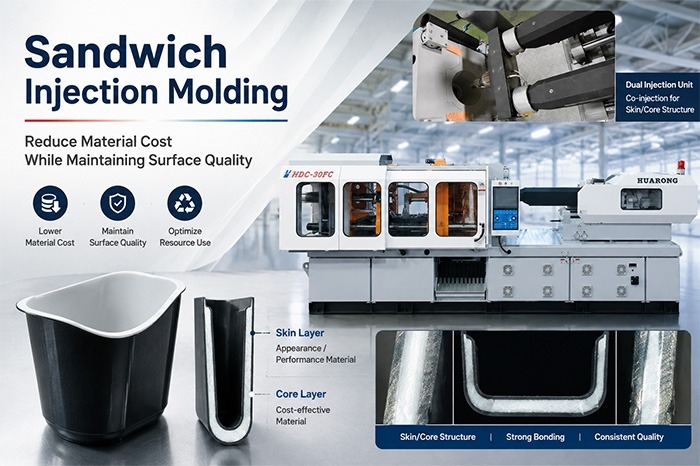
Sandwich injection molding can reduce material cost when a molded part does not require the same resin throughout its entire wall thickness. The process places an appearance or performance material on the outside of the part and a different material in the internal core.
The potential savings do not automatically come from using a sandwich injection molding machine. It comes from allocating each material only where its properties are required. Actual results depend on the achievable core ratio, the price difference between the two materials, part geometry, mold design, process stability, scrap rate, and production volume.
This article explains how the co-injection molding process creates a skin/core structure, how it can reduce material consumption, and which conditions must be controlled to preserve surface quality.
H2:What Is Sandwich Injection Molding?
Sandwich injection molding, also known as co-injection molding, is a multi-material process that creates a layered structure through the wall thickness of a molded part.
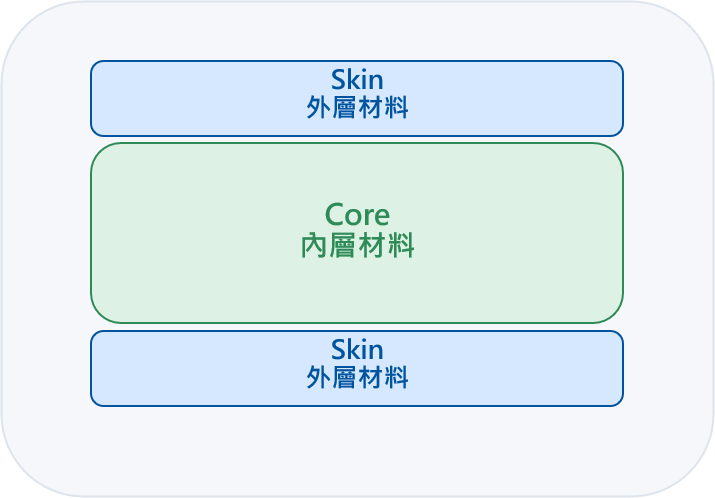
In a typical sequential process:
1. The skin material enters the cavity first and flows along the mold surface.
2. The core material is injected before the cavity is completely filled.
3. The core advances through the center of the still-molten skin material.
4. An optional final skin injection seals the gate area and helps encapsulate the core.
The completed part typically has a skin/core/skin cross-section. The visible surface is primarily determined by the skin material, while the internal layer can be selected for cost, stiffness, weight, recycled content, or another functional requirement. [1]
This differs from conventional two-shot molding. Two-shot molding usually places different materials in separate visible regions of a part. Sandwich molding places them in different layers within the same cross section.
H2:Where Does the Material Cost Reduction Come From?
The principal economic advantage is material allocation.
#穿插HTML框框
材料成本說明
* {
box-sizing: border-box;
}
body {
margin: 0;
padding: 24px;
background-color: #ffffff;
font-family: Arial, "Microsoft JhengHei", sans-serif;
color: #26313b;
}
.formula-container {
width: 100%;
max-width: 680px;
}
.formula-card {
margin-bottom: 18px;
border: 1px solid #111111;
}
.formula-title {
padding: 10px 12px;
background-color: #0f5f90;
border-bottom: 1px solid #111111;
color: #ffffff;
font-size: 14px;
font-weight: 700;
line-height: 1.3;
}
.formula-content {
min-height: 38px;
padding: 10px 12px;
background-color: #e8f1f6;
font-size: 14px;
font-weight: 600;
line-height: 1.55;
}
Material cost of a solid part
Total part weight × Price of skin material
Material cost of a sandwich molded part
Skin weight × Skin material price
+ Core weight × Core material price
Economic evaluation adjustment
Additional material handling
+ Mold or nozzle investment
+ Trial molding cost
+ Cycle time effects
+ Scrap and quality inspection cost
This calculation is more reliable than promising a universal percentage.
H3:A Simple Illustrative Example
Assume a hypothetical part weighs 1 kg.
| Item | Solid Premium Resin Part | Sandwich Molded Part |
|---|---|---|
| Skin material price | USD 2.00/kg | USD 2.00/kg |
| Core material price | Not applicable | USD 1.00/kg |
| Skin proportion | 100% | 55% |
| Core proportion | 0% | 45% |
| Resin cost per part | USD 2.00 | USD 1.55 |
In this example, the gross resin saving is USD 0.45 per part, or 22.5%, before equipment, mold, processing, and quality costs are included.
H2:Three Ways a Core Layer Can Create Economic Value
H3:1. Replacing Part of the Virgin Resin
The skin can use virgin or appearance-grade resin, while the core uses compatible regrind, post-industrial recycled material, or qualified post-consumer recycled material.
A peer-reviewed case study produced a reusable polypropylene transport box with 45 wt% recycled material in the core. The study also found an important limitation: contaminants in the recyclate did not significantly reduce stiffness-controlled performance, but they did affect strength-controlled and impact-related properties. This shows why a good external appearance does not remove the need for mechanical validation.
H3:2. Using a Foamed Core
A foamed core can reduce part weight and material consumption while the compact skin helps control visible surface appearance.
Foamed sandwich structures may also help reduce sink marks in appropriate geometries. The result still depends on part thickness, mold temperature, foaming conditions, and skin coverage. Industrial sandwich molding examples include parts made with solid PP skin and a foamed PP regrind core.
H3:3. Separating Surface and Structural Requirements
The surface material can be selected for color, gloss, chemical resistance, touch, or weather resistance. The core can be selected separately for stiffness, weight, recycled content, or cost.
This avoids specifying an expensive material throughout the full wall when its premium properties are only required at the surface.
#HTML框框
A reinforced core should not automatically be described as a cost-saving
material. Glass-filled or mineral-filled resin may cost more than the skin
material. Its value may instead come from
increasing stiffness,
controlling deformation, or
enabling a thinner product design.
H2:How Does the Process Maintain Surface Quality?
Surface quality is maintained by forming a sufficiently continuous skin layer before and during core injection.
The core must remain inside the part. When the core overtakes the skin flow front and reaches the mold surface, the defect is commonly called core breakthrough or exposed core.
H3:1. Skin Shot Volume and Switchover Position
The first skin shot must provide enough material to cover the cavity surface and remain continuous while the core advances.
Switching to the core too early may create:
· Exposed core
· Uneven color
· Surface streaks
· Insufficient coverage near corners or thin sections
Switching too late may reduce the achievable core volume and limit the economic benefit.
There is no universal skin/core ratio. Industrial suppliers have reported project-specific core proportions ranging from approximately 15% to 65%, while individual applications have achieved around 45 wt% recycled core or 60% regrind core. These examples should be treated as application results, not general design guarantees.
H3:2. Melt Viscosity and Temperature
The relative viscosities of the skin and core materials affect the shape, thickness, and penetration depth of the core.
Experimental and numerical research has shown that core penetration changes with skin viscosity, core viscosity, melt temperature, injection speed, and the delay before core injection. A higher core viscosity can produce a thicker but shorter core region, while changes in skin temperature can alter skin thickness and penetration depth. [4]
The process engineer should therefore evaluate viscosity under actual shear rate and processing temperature, rather than comparing only the melt flow index values printed on resin data sheets.
H3:3. Part Geometry
The core tends to travel through the center of the melt flow path. Its distribution is influenced by:
· Wall thickness changes
· Sharp corners
· Ribs and bosses
· Flow hesitation areas
· Weld lines
· Gate position
· Flow length
Rounded transitions generally provide a more controllable flow path than sharp corners. Weld-line areas require particular attention because the core may not penetrate these regions in the same manner as the surrounding wall.
Thin walls can also restrict the available space for a stable core layer. One industrial supplier recommends at least 1.5 mm wall thickness for a high core proportion, but the practical limit still depends on resin rheology, geometry, and the required skin thickness.
Further reading: Thin Wall Injection Molding: Key Technology for Efficient and Lightweight Manufacturing
H3:4. Gate and Runner Design
The gate-and-runner system must support the planned injection sequence without allowing premature skin freezing or uncontrolled core exposure.
Depending on the machine and mold configuration, the system may use a dedicated co-injection nozzle, a specialized runner arrangement, or an application-specific hot runner solution.
It is not correct to assume that every sandwich molding project requires the same gate or valve-gate system. The appropriate design must be selected according to the part, mold, material pair, and required encapsulation.
Further reading: Sprue, Runner, and Gate in Injection Molding: A Practical Guide
H3:5. Material Compatibility and Shrinkage
Materials from the same polymer family often provide a more manageable starting point. Examples include virgin PP with recycled PP, or virgin ABS with compatible ABS regrind.
Different polymer families may require a compatibilizer, an adhesion layer, or another material strategy. Similar processing temperatures do not automatically guarantee sufficient bonding.
The following properties should be evaluated before production:
· Processing temperature range
· Viscosity under actual molding conditions
· Mold shrinkage
· Interfacial adhesion
· Thermal expansion
· Moisture sensitivity
· Additive compatibility
· End-use chemical and temperature exposure
A surface that looks acceptable immediately after molding may still fail through delamination, warpage, impact loading, or thermal cycling.
H2:Can Sandwich Molding Guarantee the Same Surface as a Solid Part?
No process should guarantee identical surface quality before the material, mold, and operating window have been validated.
A correctly formed skin layer can allow the visible surface to retain the color, gloss, texture, and appearance of the selected skin material. However, surface results can still be affected by:
· Core breakthrough
· Flow marks during material switchover
· Uneven skin thickness
· Warpage
· Gate appearance
· Recycled material contamination
· Variations between molding cycles
- #HTML框框
- Technically accurate statement: Sandwich injection molding can allow the outer skin material to control the visible surface while a different material is placed in the internal core, provided that the material pair, part design, mold, and process window are properly validated.
H2:Which Products Are Good Candidates?
Sandwich injection molding is most attractive when the product has a significant material volume, and the surface requirements differ from the internal requirements.
H3:Logistics and Industrial Products
Transport boxes, containers, pallets, bins, and similar products can use a controlled-surface material with a recycled or foamed core.
These products are often suitable for feasibility evaluation because they have sufficient wall thickness and consume a relatively large amount of resin per part.
H3:Consumer and Appliance Housings
Appliance panels, tool housings, furniture components, and other visible products may use an appearance-grade skin with a compatible recycled or functional core.
Impact resistance, screw boss performance, and drop testing still need to be evaluated using the final layer distribution.
H3:Automotive Interior Components
Interior covers, handles, and trim components may benefit from separating appearance requirements from stiffness or weight requirements.
Automotive applications require validation for dimensional stability, odor, VOC compliance, temperature cycling, impact resistance, and long-term material aging.
H3:Packaging and Barrier Applications
Co-injection can position a barrier or functional material within a packaging wall. Sequential co-injection can also encapsulate a core at the gate if the final skin-sealing phase is properly controlled.
For food-contact products, complete encapsulation alone does not establish regulatory compliance. Resin approval, migration performance, gate and trimming exposure, manufacturing conditions, and destination-market regulations must all be reviewed.
#圖片: https://www.moldmasters.com/sites/default/files/inline-images/Coinjection-Flow-1024x771.jpg
H2:When Is Sandwich Injection Molding Less Suitable?
The process may not be the best choice when:
· The wall is too thin to establish a stable core.
· The part has many sharp transitions or difficult weld-line regions.
· The internal material may become exposed through machining, trimming, or wear.
· Mechanical properties must remain highly consistent but the recycled material varies significantly.
· Annual production volume does not justify mold and process development.
· The two materials have incompatible processing temperatures or shrinkage.
· The part cannot tolerate variation in layer distribution.
· Surface and core properties cannot be validated separately.
A feasibility study should be completed before equipment selection or mold modification.
H2:Sandwich Molding Compared with Other Material Reduction Methods
| Method | Main Principle | Surface Consideration | Best Suited To |
|---|---|---|---|
| Sandwich co-injection | Places a different material inside the wall | Surface is primarily controlled by the skin | Parts requiring a defined visible surface and a different internal material |
| Foaming | Creates cells inside the polymer | Surface streaking or texture may require additional control | Weight reduction, sink control, and structural products |
| Thin-wall molding | Reduces the total wall thickness | Surface can remain uniform, but filling demand increases | Packaging and high-volume thin products |
| Blending regrind into virgin resin | Mixes recycled content throughout the part | Color and surface variation may remain visible | Non-cosmetic or internally used parts |
| Adding fillers | Changes stiffness, shrinkage, or cost | Fibers or minerals may affect appearance | Structural or concealed components |
Sandwich molding should therefore be considered one option within a wider material and product design strategy, not a universal replacement for every cost-reduction method.
H2:What Machine Capabilities Are Required?
A stable co-injection molding process normally requires the following functions.
#圖片: https://www.huarong.com.tw/uploads/product_machine/HDC-co-injection-molding-machine.webp
H3:Independent Injection Control
The skin and core materials require independent plasticizing and control of:
· Barrel temperature
· Screw speed
· Back pressure
· Injection speed
· Injection pressure
· Shot volume
· Switchover position
H3:Coordinated Injection Sequence
The controller must coordinate the skin injection, core injection, and optional skin sealing phase.
Repeatable switching is essential because small variations in shot volume or switching position can change the visible surface and the internal layer distribution.
H2:Huarong HRM Series Sandwich Injection Molding Platform
Huarong is continuing trial molding and process development for mixed injection and sandwich injection applications.
The HRM Series uses separate skin and core injection units together with a co-injection flow system and coordinated process control. The configuration allows the operator to set the injection volume, switching point, speed, pressure, and holding conditions for the planned skin/core sequence.
The exhibition model is the HRM-200, a 200 ton sandwich injection molding machine. The same multi-injection development platform may also be evaluated for other molding effects, such as marbling, split material patterns, or gradient transitions. These effects require different nozzle, runner, mold, material, and control configurations, and should not be treated as functions that every standard setup can perform without modification.
H2:See the HRM-200 at TaipeiPLAS 2026
Huarong will exhibit the HRM-200 sandwich injection molding machine at TaipeiPLAS 2026.
The exhibition will take place from September 15 to 19, 2026, at Taipei Nangang Exhibition Center, Hall 1. The official show theme focuses on smart manufacturing, innovative materials, sustainability, and the circular economy.
Visitors preparing a sandwich molding project are encouraged to bring:
· Part drawings
· Wall thickness information
· Current and proposed resin grades
· Annual production volume
· Surface quality requirements
· Recycled content targets
· Mechanical and regulatory requirements
These inputs allow a more meaningful evaluation of the achievable core distribution, machine configuration, mold design, and expected economic benefit.
H2:Frequently Asked Questions
H3:Is sandwich injection molding the same as two-shot molding?
No. Sandwich injection molding creates different layers through the wall thickness of one molded part. Conventional two-shot molding generally places materials in separate visible regions using mold movement, rotation, or separate cavities.
H3:Can recycled material be used in the core?
Yes, recycled material is one of the main potential applications. The recycled resin must still be evaluated for melt consistency, contamination, moisture, odor, shrinkage, and mechanical performance. A clean external surface does not guarantee that the internal recycled material will satisfy impact, fatigue, or long-term reliability requirements.
H3:Can an existing mold be used?
Possibly. The existing gate, runner, venting, and part geometry must support the sequential flow of two materials. Some molds may be suitable after modification. Other products may require a new mold or a dedicated co-injection runner design.
H2:Conclusion
Sandwich injection molding can reduce material cost by placing a premium material only where its appearance or performance is needed and using a different material in the internal core.
Its effectiveness depends on more than the injection machine. Material rheology, product geometry, gate design, layer distribution, recycled material quality, and process repeatability must all be validated.
For suitable products, the process provides a practical way to combine surface quality, recycled content, lightweight design, and functional material distribution within one molded component.
Huarong’s HRM Series is being developed to support these layered and mixed-material applications through independent injection control and a dedicated co-injection configuration.